

It’s been nearly 45 days since the end of Q2 of 2026-
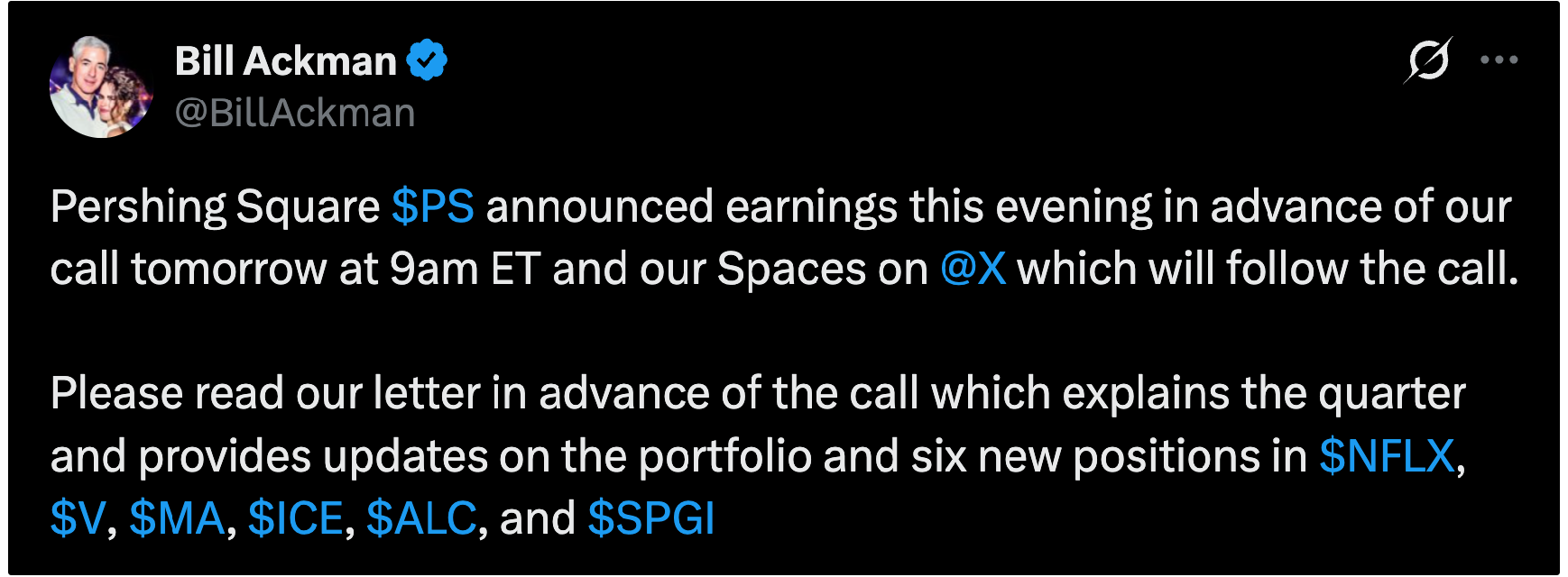
Which means investors with over $100M in assets under management are having to file their form 13Fs, revealing all the moves they made last quarter.
What was most interesting about Ackman’s moves?
The fact he added four companies that sit at the center of the global financial system:
Mastercard
Visa
S&P Global
Intercontinental Exchange
All four of these stocks have underperformed the market in the last year.
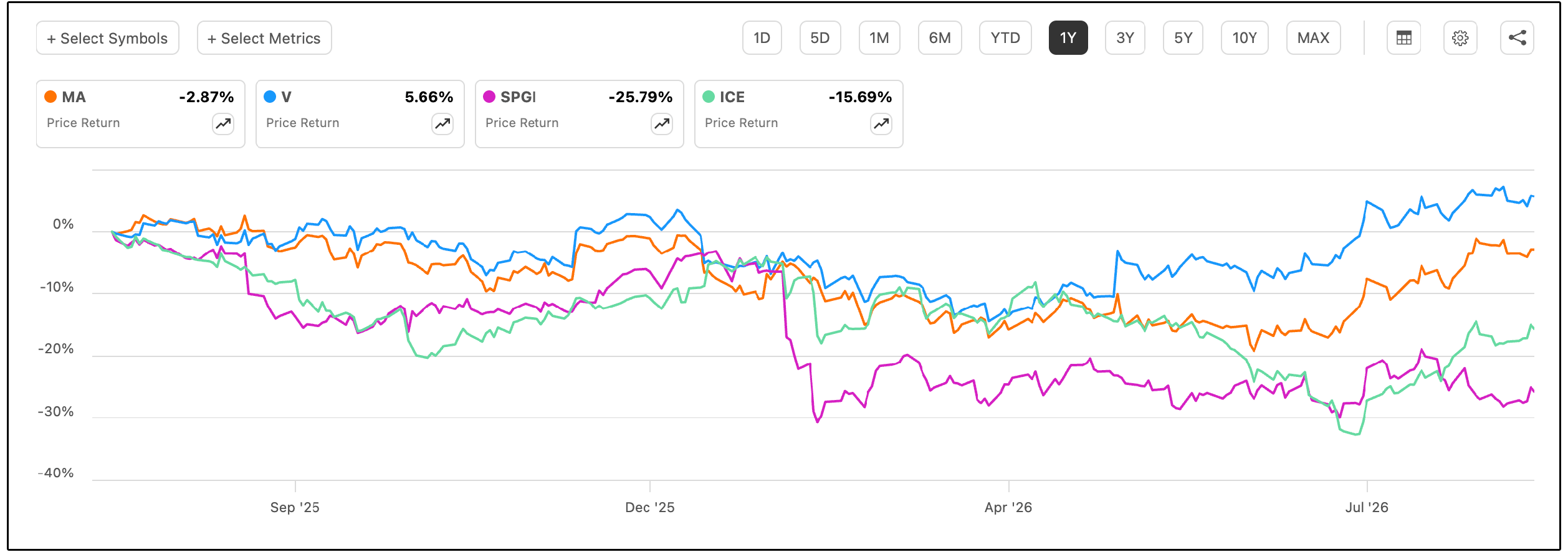
While each of these companies is different in nature-
They have some incredibly similar characteristics.
They are all capital-light financial toll roads businesses.
Every time a payment is processed, a financial benchmark is licensed, a credit rating is issued, or a trade is completed, one of these companies collects a small fee.
Here’s everything you need to know about why Ackman added these dividend growth stock positions to his portfolio.
📈 Sources of Returns
Let’s use Mastercard as a case study.
Nearly 9 months ago, I released a video stating that Bill Ackman was likely to buy two stocks in particular:
Meta
Mastercard
Since that video, he has added both of those to his portfolio.
How did I know this was likely to happen?
The true answer is that I deeply understand his investing philosophy by reading his lengthy letter’s to shareholders.
But the short answer is this:
Ackman views investment’s through the lens of sources of returns.
Over the long term, a stock has three primary sources of return:
Earnings-per-share growth
Dividends
Changes in the valuation multiple
Dividends are the most direct source of return.
They represent actual cash paid to shareholders and can provide positive returns even when earnings stagnate or valuation multiples contract.
However, the two primary engines of long-term outperformance are EPS growth and multiple expansion.
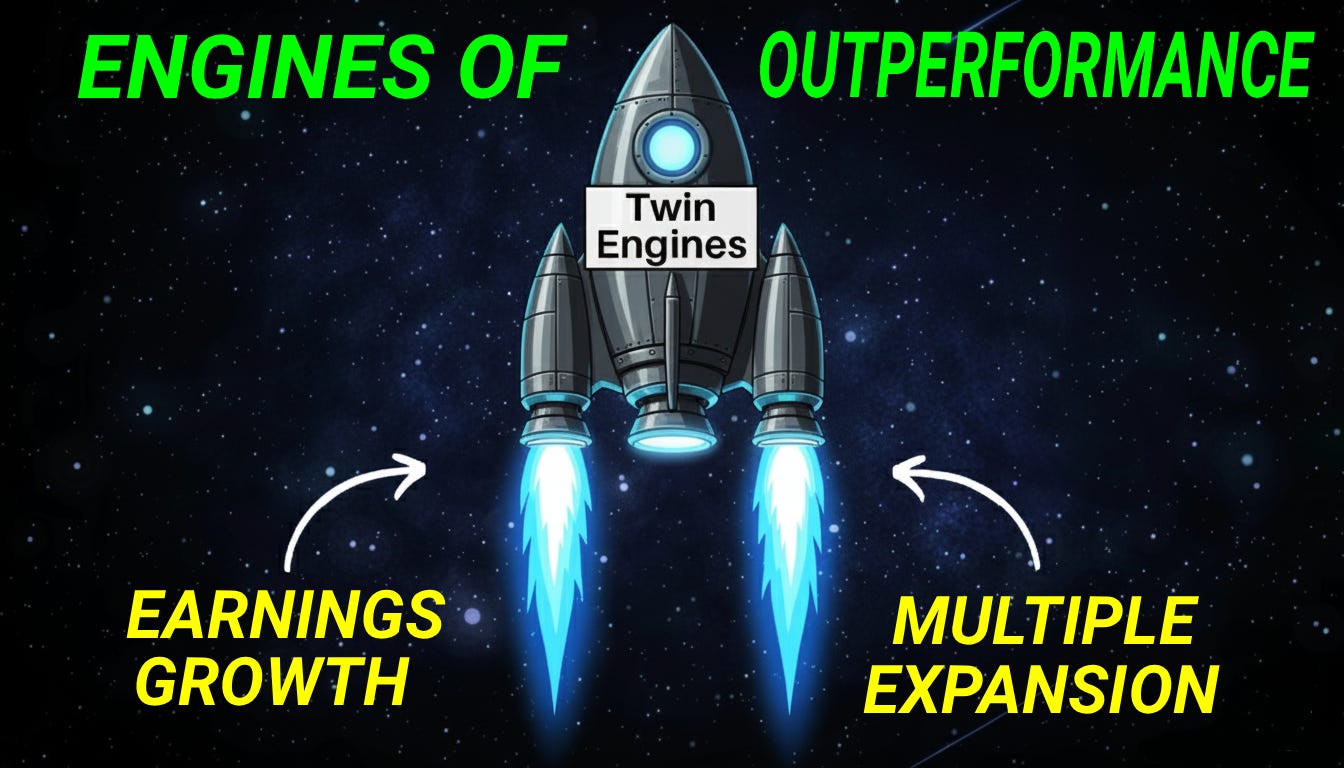
If a company grows EPS by 15% annually, its share price will follow that growth, assuming its valuation multiple remains unchanged.
If the valuation multiple also expands, investors receive an additional boost.
The math behind this is simple.
Let’s say we have a stock that grows earnings per share at 15% per year.
At a 15% annual growth rate, earnings would double in about 4.8 years
Assuming that:
The stock doesn’t pay dividends
The P/E multiple stays the same
This means that the share price of the stock over the 4.8 year time period would double as well.
A 100% gain in just 4.8 years!
But let’s run this scenario one more time…
This time we will assume the stock is trading at a price to earnings multiple of 15.
Like above the stock continues to grow earnings per share at a rate of 15%.
But at the end of the 4.8 year period, the company is trading at a P/E multiple of 25.
To review:
EPS grows at 15%
The P/E multiple expands from 15 to 25
This means the stock would provide a total return of 234% in just 4.8 years!
Share repurchases are not treated as a separate source of return in this framework because their benefit is already captured through EPS growth.
When a company reduces its outstanding share count, its earnings are divided across fewer shares, accelerating earnings growth on a per-share basis.
But these sources of return are not equally dependable.
A company can trade at a lower valuation for years.
Multiple expansion is never guaranteed.
Earnings growth, on the other hand, is ultimately what drives intrinsic value.
Ackman made this exact point in Pershing Square’s second-quarter shareholder letter:
“In the short term, stock prices are often, and sometimes materially, disconnected – either favorably or unfavorably – from intrinsic values. Over the long term we expect long-term growth in EPS and economic earnings to drive increases in the intrinsic value and stock prices of our holdings.”
That is the foundation of the Mastercard investment thesis.
Pershing Square believes it purchased a high-quality company with the ability to compound earnings at a double-digit rate while trading below its historical valuation.
In other words, Mastercard potentially has both engines of outperformance working in its favor:
Continued earnings growth
Potential multiple expansion
But with that being said, Mastercard’s capital-allocation strategy may be the most misunderstood, yet impressive parts of the entire business.
🧭 The Five Uses of Capital
I state this all the time, and will continue to do so.
Every company has five basic ways it can allocate its free cash flow:
Reinvest in the existing business
Make acquisitions
Pay down debt
Repurchase shares
Pay dividends
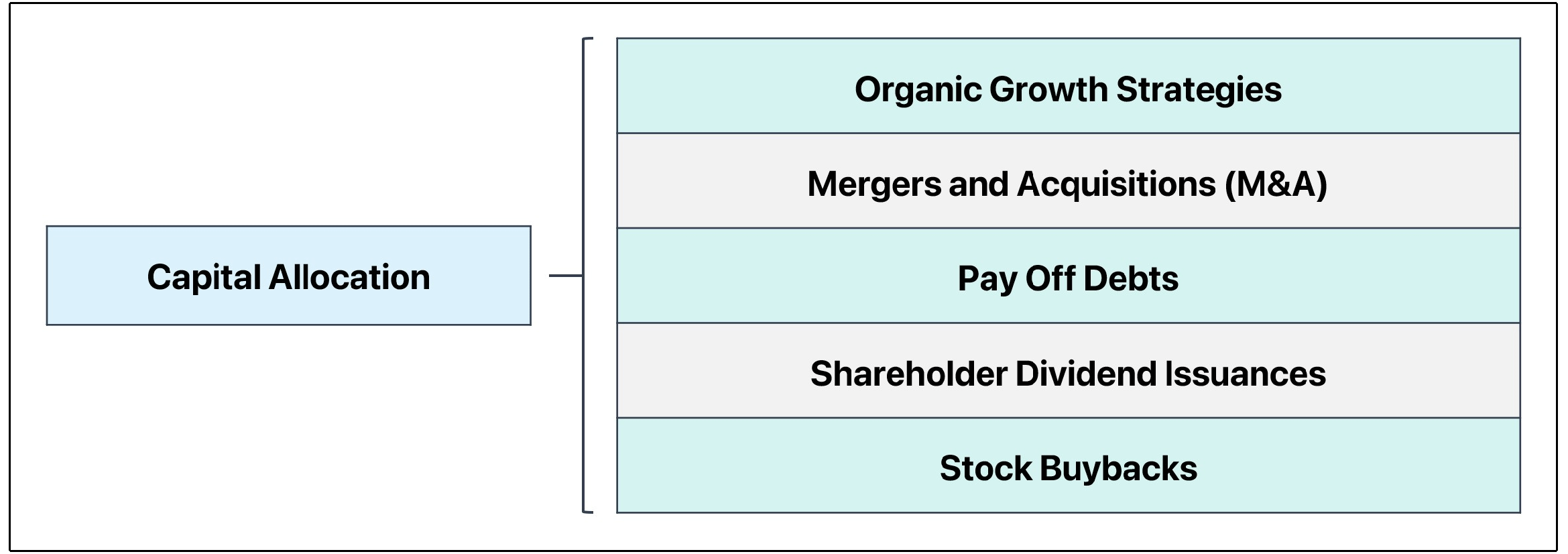
Management’s most important responsibility is deciding how much capital should flow into each category.
The correct decision depends on the opportunities available.
If a company can reinvest capital at exceptionally high rates of return, it should reinvest.
If it can purchase another business at an attractive valuation and generate returns above its cost of capital, it should consider an acquisition.
But if neither opportunity exists, management should return the excess cash to shareholders.
Holding unnecessary cash or forcing capital into mediocre projects destroy’s shareholder value.
This is what makes Mastercard so unique.
As we will see below, the company can continue growing at a double-digit rate without reinvesting most of its free cash flow.
💳 Mastercard’s Unusual Advantage
In 2025, Mastercard generated $16.9B in free cash flow.
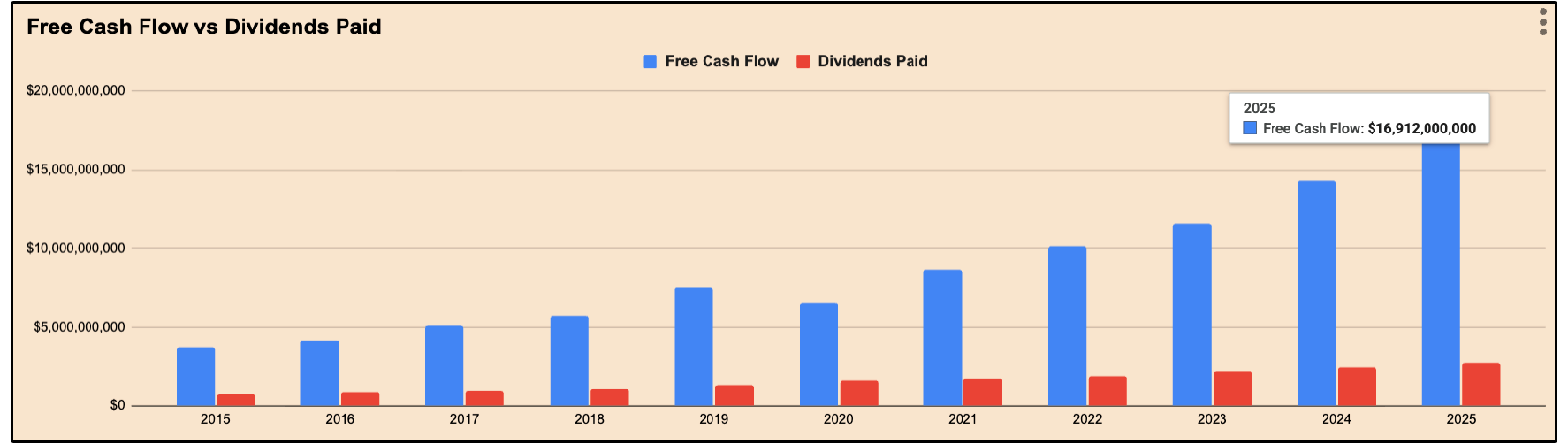
But how did they allocate this capital?
Mastercard had a 16.3% free cash flow payout ratio in 2025, meaning 16.3% of their free cash flow used used to pay dividends.
This is where most investors stop their capital allocation research.
You can often times back into how much capital was used to buyback shares by reviewing changes in shares outstanding, or sometimes the company will state this in their financials.
Now look at how management allocated that cash:
$11.73 billion spent repurchasing shares
$2.76 billion paid in dividends
$14.48 billion returned to shareholders in total
That means Mastercard returned approximately 86% of its free cash flow through dividends and buybacks in 2025!
Nearly all of their free cash flow is being returned to shareholders.
Is returning this much cash a red flag?
Often times it is.

If a company distributes nearly all of its free cash flow because its business has stopped growing, the payout can be a warning sign.
A mature company may have no attractive reinvestment opportunities, leaving dividends and buybacks as the only realistic uses of its capital.
But what if a company could return most of its cash while still expanding earnings at a double-digit rate?
That’s exactly what Mastercard does.
Its payment network is already built.
The company does not have to manufacture every Mastercard-branded card, fund the underlying consumer loans, or construct a physical location every time it enters a new market.
Instead, banks issue the cards, merchants accept them, and Mastercard operates the network connecting both sides.
As more consumers use digital payments and more merchants join the network, Mastercard can process more transactions across much of the same infrastructure.

That is the power of a network effect.
More acceptance makes the network more useful to consumers.
More consumers make the network more valuable to merchants.
More transactions generate additional data.
More data strengthens fraud detection and other value-added services.
Better services make the network even more difficult to replace.
Mastercard does not need to retain most of its free cash flow to build factories, purchase inventory, or finance customer loans.
That allows revenue and earnings to grow much faster than the company’s physical capital base.
💎 The Power of High ROIC
This brings us to return on invested capital.
ROIC measures how efficiently a company generates after-tax operating profit from the capital invested in its business.
The basic formula is:
ROIC = Net Operating Profit After Tax ÷ Invested Capital
Think of a company as a vehicle.
Invested capital is the fuel
Operating profit is the distance traveled
ROIC measures how efficiently the vehicle converts fuel into distance
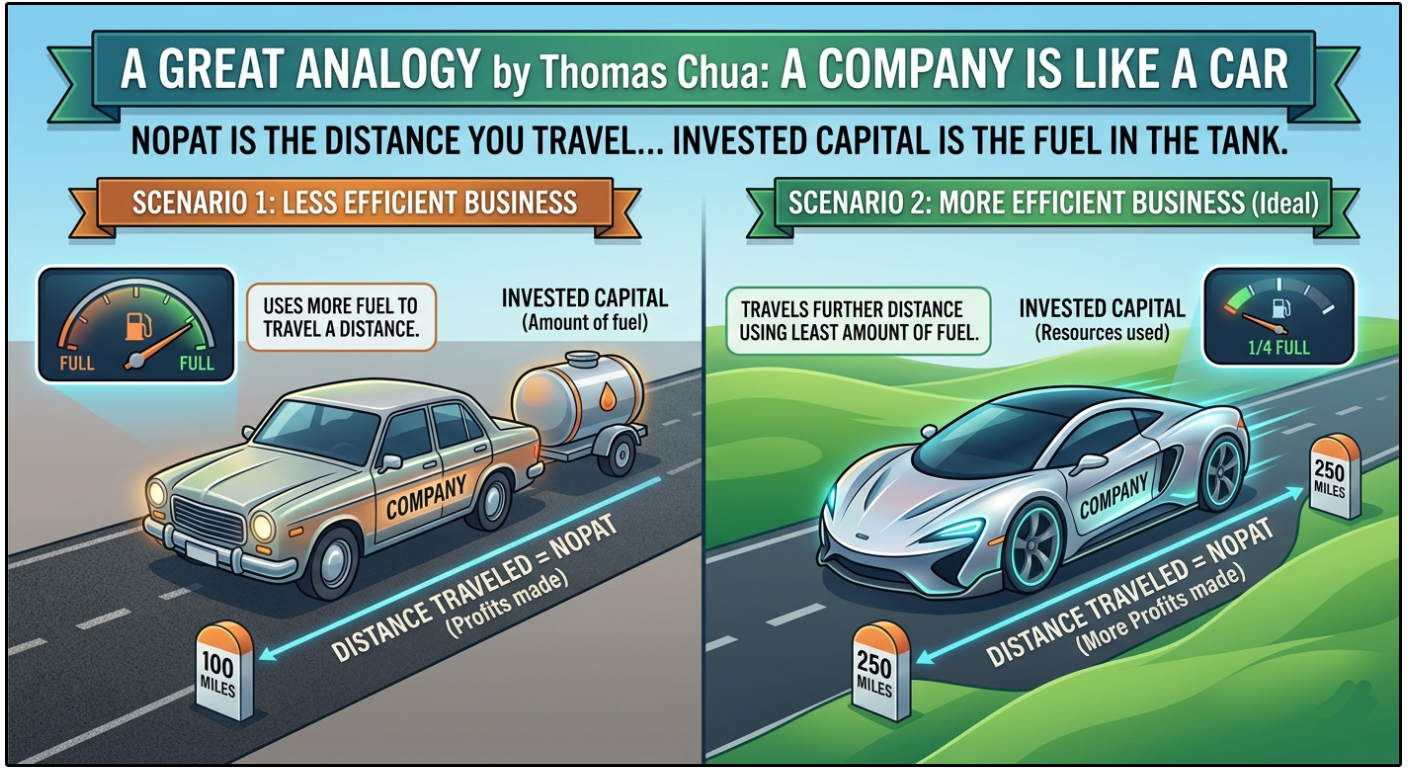
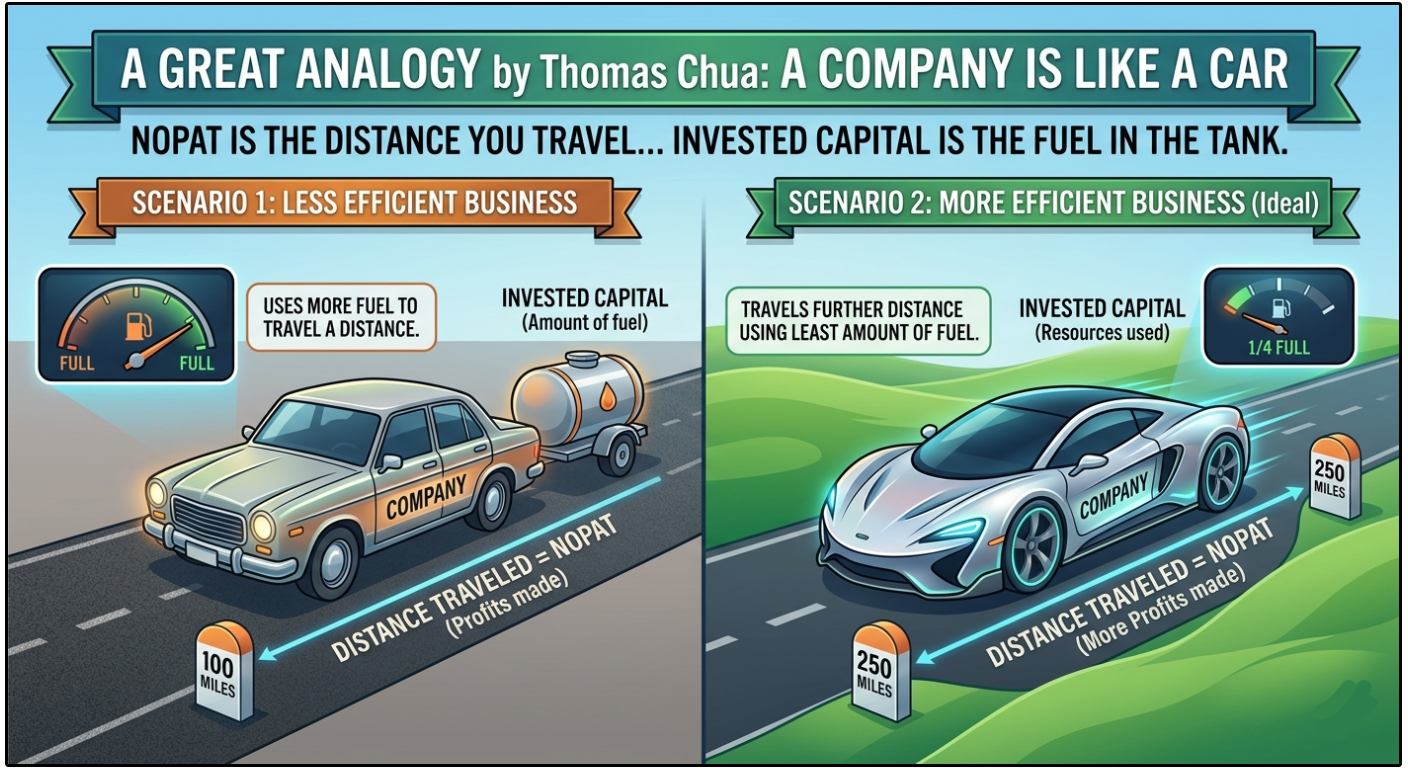
The higher the ROIC, the more profit the company can generate from each dollar invested.
Mastercard’s ROIC reached an exceptional 48.91% in 2025.
In simple terms, this means Mastercard generated nearly $49 in after-tax operating profit for every $100 of capital invested in the business.
This becomes even more powerful when we connect ROIC to the company’s reinvestment rate.
The relationship between the two can be expressed with a simple formula:
Expected Growth = ROIC × Reinvestment Rate
We already established that Mastercard generated approximately $16.912 billion in free cash flow during 2025 and returned $14.483 billion through dividends and share repurchases.
That left approximately $2.429 billion of free cash flow that was not returned to shareholders.
Mastercard’s estimated reinvestment rate can therefore be calculated as:
$2.429 billion ÷ $16.912 billion = 14.36%
In other words, Mastercard retained only around 14.4% of its free cash flow after accounting for dividends and buybacks.
Now multiply that reinvestment rate by Mastercard’s ROIC:
48.91% ROIC × 14.36% reinvestment rate = 7.02% implied growth
Based on this simplified framework, Mastercard could theoretically grow its underlying business by approximately 7% per year while reinvesting less than 15% of its free cash flow.
That is the power of high ROIC.
A company earning a 10% ROIC would need to reinvest approximately 70% of its capital to generate the same 7% growth.
Mastercard can potentially generate that growth while returning approximately 86% of its free cash flow to shareholders.
It gets far more growth from every dollar retained.

There is also an important caveat.
This is a simplified cash-retention calculation, not the strict accounting definition of a reinvestment rate.
Mastercard invests heavily in technology, cybersecurity, employees, artificial intelligence, customer incentives, and product development.
Much of that investment is recorded as an operating expense rather than appearing as capital expenditures on the cash-flow statement.
That means our calculation technically understates how much Mastercard is truly reinvesting for future growth.
But the broader takeaway remains unchanged:
Mastercard does not need to retain most of its free cash flow to keep growing.
This is what separates Mastercard from a traditional capital-intensive company.
It can return nearly all of its free cash flow to shareholders without starving the business of the capital it needs to grow.
That is the defining characteristic of a capital-light compounding machine.
🚀 Engines of Outperformance
Bill Ackman added Mastercard when it was trading at it’s lowest P/E multiple in over 5 years.
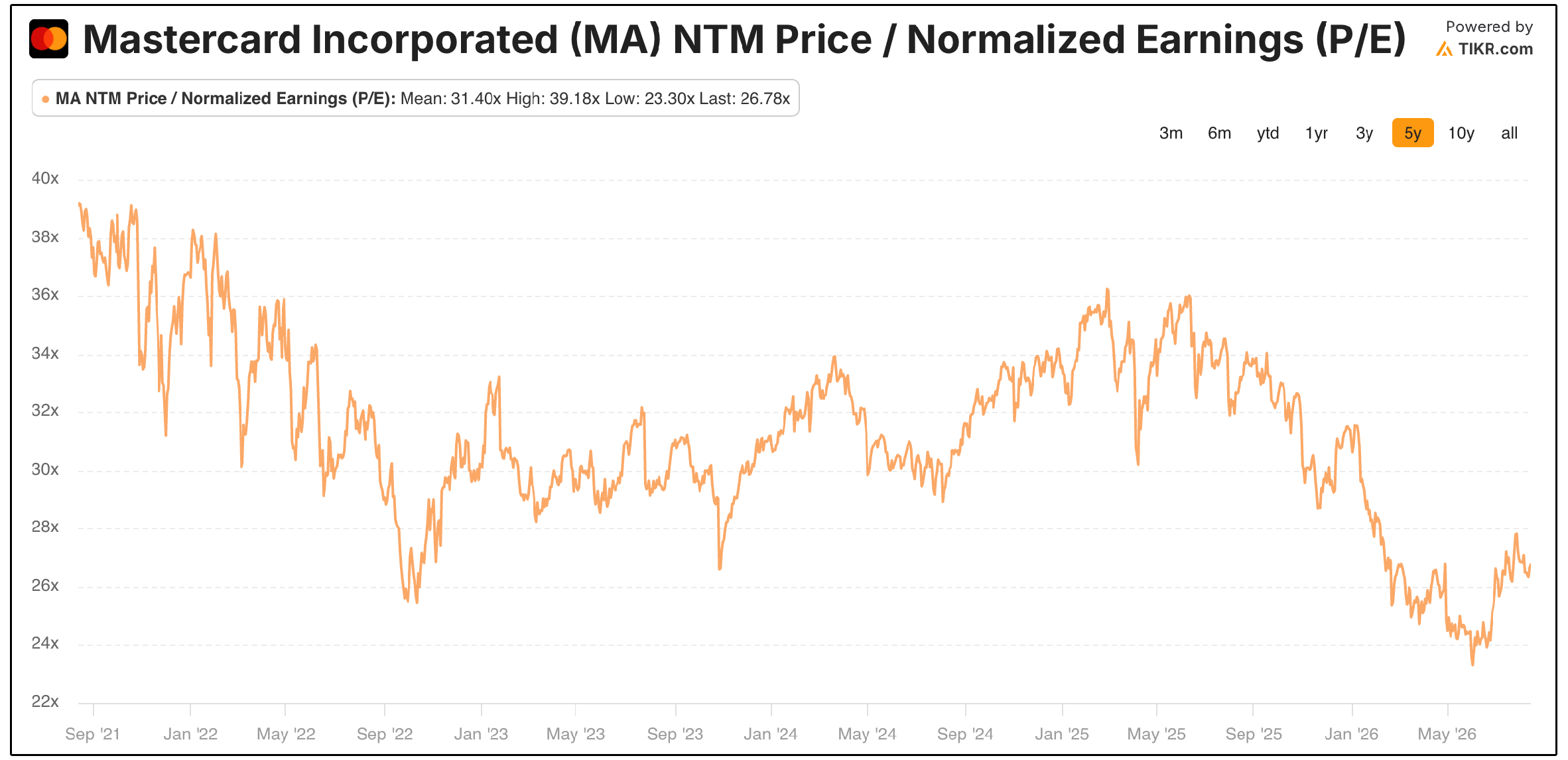
As mentioned above, this allows him to benefit from both engines of outperformance.
Assuming Mastercard’s EPS growth comes in slightly below analysts projections, and the valuation multiple expands just slightly closer to its historic average-
Compounded returns are sitting above 15%!
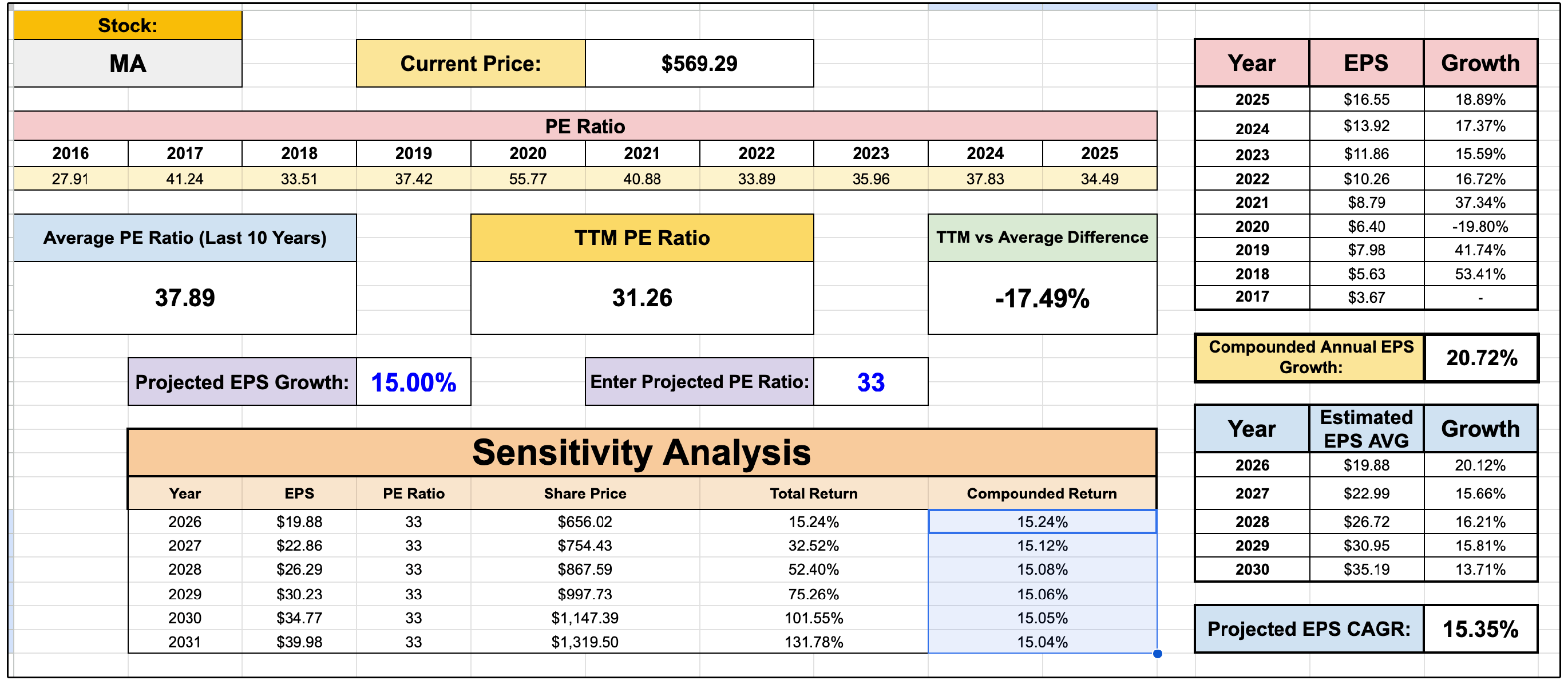
This is a great example of a stock that benefits from both of the engine’s of outperformance.
⚠️ The Risks
The market has had two major concerns for Mastercard as of late:
Stablecoins
Agentic commerce
Here’s what investors are missing.
The world will still have a desperate need for payment verification and fraud prevention.
Here’s a few key quote from Mastercard CEO, Michael Miebach-
“By 2030, the amount of fraud and cyber risk-driven damage is going to amount to $15.6 trillion. If cyber risk were a country, that would be the third largest economy in the world.”
“We’re the operating system of the digital economy. An operating system should have a security layer. That’s exactly what we do. But it also has a money movement layer--across stablecoins and account-to-account and cards. We move value, your hard-earned money.”
“You’re company A, I’m company B, and we just want to do machine-to-machine payments with each other. But your choice is stablecoin A and my choice is stablecoin B. Who sits in the middle and drives interoperability, makes sure all of this connects and is not a plate full of spaghetti? Mastercard’s.”
Mastercard is well positioned to not only manage what some see as risks, but potentially benefit from them.
🛒 Bill Ackman’s Buy
A stock returning nearly 86% of its 2025 free cash flow through dividends and share repurchases, while also still growing EPS at roughly 15% moving forward is incredibly rare.
But that is exactly what Mastercard has done.
What’s interesting, is Mastercard shares many of the same qualities as Bill Ackman’s other financial purchases:
S&P Global
Visa
ICE
All four are capital light businesses that require little reinvest back into the business to fund growth.
And every additional transaction, credit rating, financial-data subscription, or index-linked product can generate more revenue without requiring a proportional increase in invested capital.
This allows them to produce exceptional returns on invested capital and convert a significant portion of their earnings into free cash flow.
In fact, these qualities are quite similar to the qualities our Dividend Growth Portfolio possesses.

If you want to get access to our Dividend Growth and High Yield Portfolio, as well as all the features mentioned below, you can do so here:
See you soon!
Dividendology
Very good as always
Ackman bought the toll roads after they lagged the carnival. Visa and Mastercard don't need a narrative. They need people to keep tapping plastic. The 13F is just the receipt.