

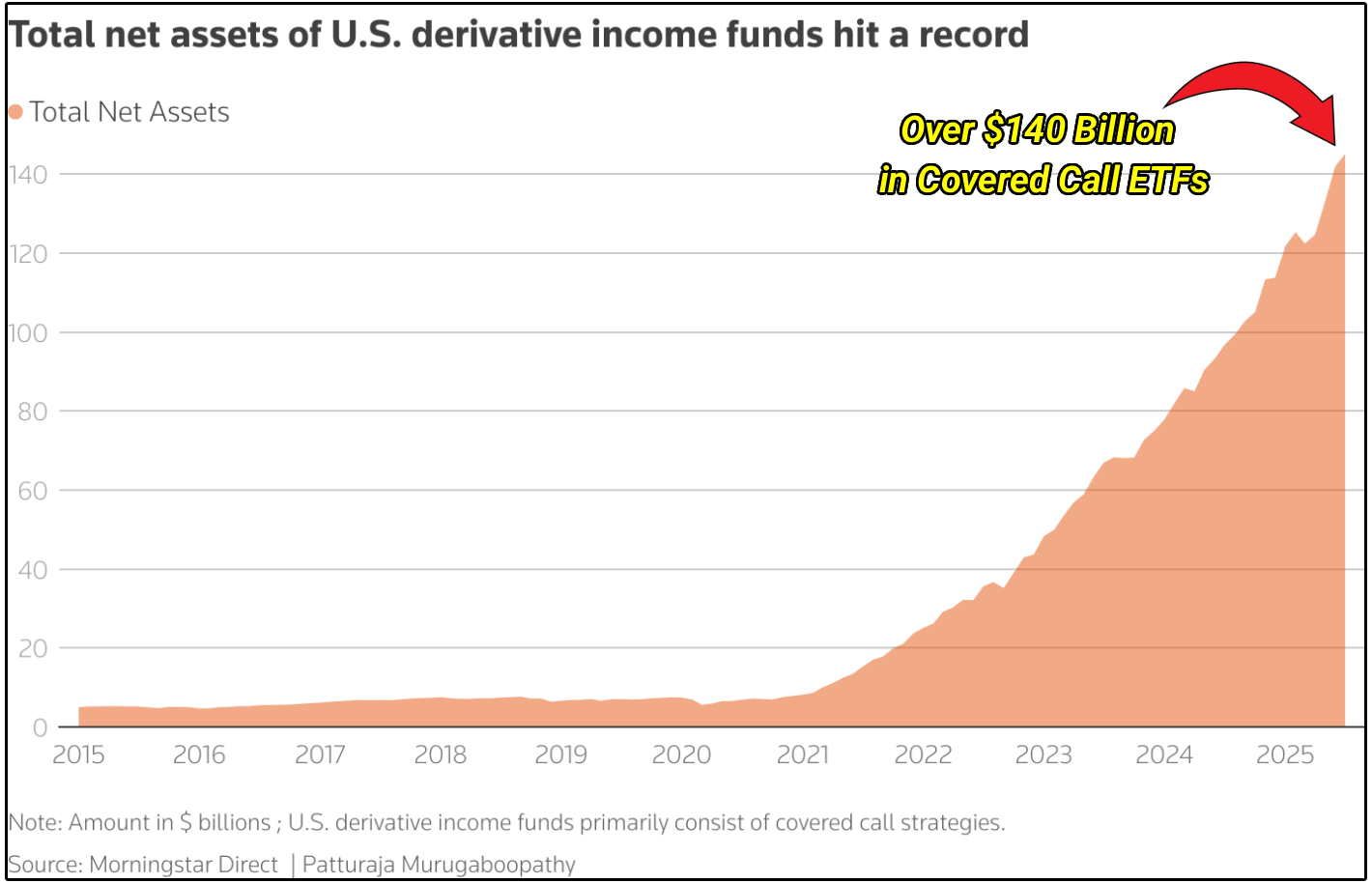
Covered Call ETFs have become one of the fastest-growing areas of the investment market.
Total assets in U.S. derivative-income funds climbed above $140 billion by the end of 2025, up from less than $10 billion just a few years ago.
However, the vast majority of investors still don’t understand how these funds are structured.
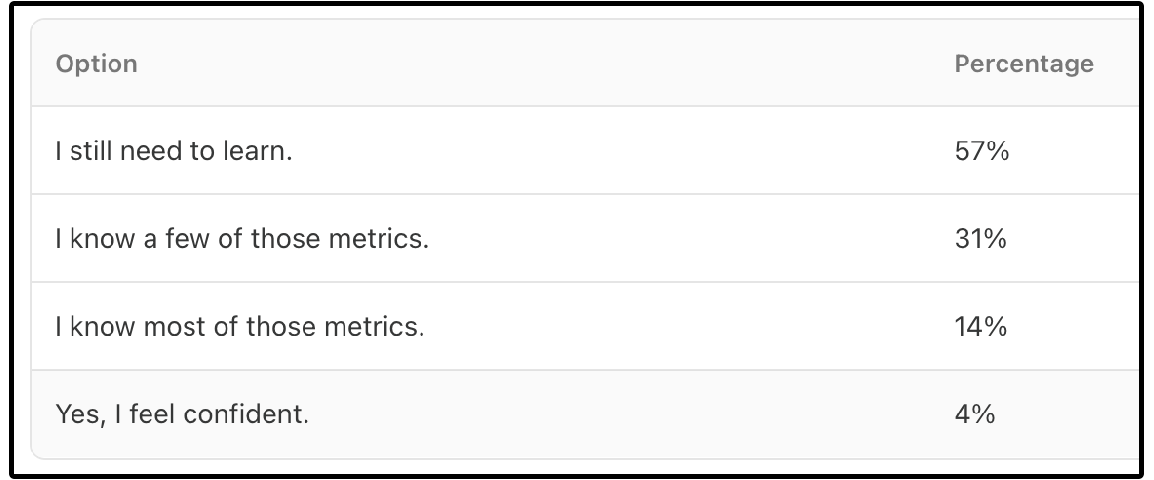
Last year, I sent out a poll asking my newsletter readers how comfortable they felt analyzing and understanding the key metrics for these ETFs/ETPs.
Only 4% felt confident!
Today, we will be taking a deep dive on how Covered Call ETFs/ETPs work-
While using real examples from IncomeShares.
Before we jump in, a special thank-you to IncomeShares for sponsoring today’s newsletter and helping make this educational breakdown possible.
📘 IncomeShares
IncomeShares is a European provider of high-yield exchange-traded products designed to generate monthly income through options strategies.
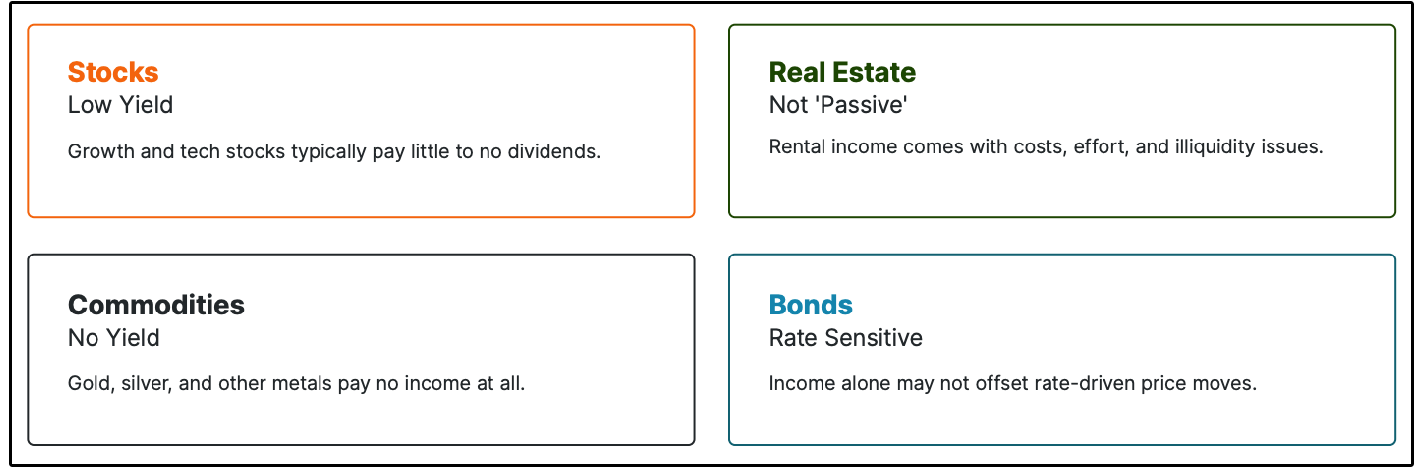
Each traditional asset class has limitations for income investors:
Growth stocks may pay little or no dividend
Real estate can generate income, but direct ownership requires time, expenses, and management
Commodities generally produce no income at all
This makes commodities particularly interesting.
Investors may want exposure to gold as a potential store of value, silver as both a precious and industrial metal, or oil as a way to participate in global energy demand.
However, simply owning the asset does not create cash flow.
Commodity option-income ETPs seek to combine exposure to these assets with an actively managed options strategy.
Rather than waiting for the commodity to appreciate, the strategy repeatedly sells options in an attempt to generate recurring income.
Let’s review exactly how they generate income from commodities.
🧩 What Is a Covered Call Option?
A covered call is an options strategy that combines two positions:
Owning an asset
Selling a call option on that asset
A call option gives its buyer the right, but not the obligation, to purchase an asset at a predetermined price, known as the strike price, before the option expires.
The buyer pays the seller an upfront fee called an option premium.
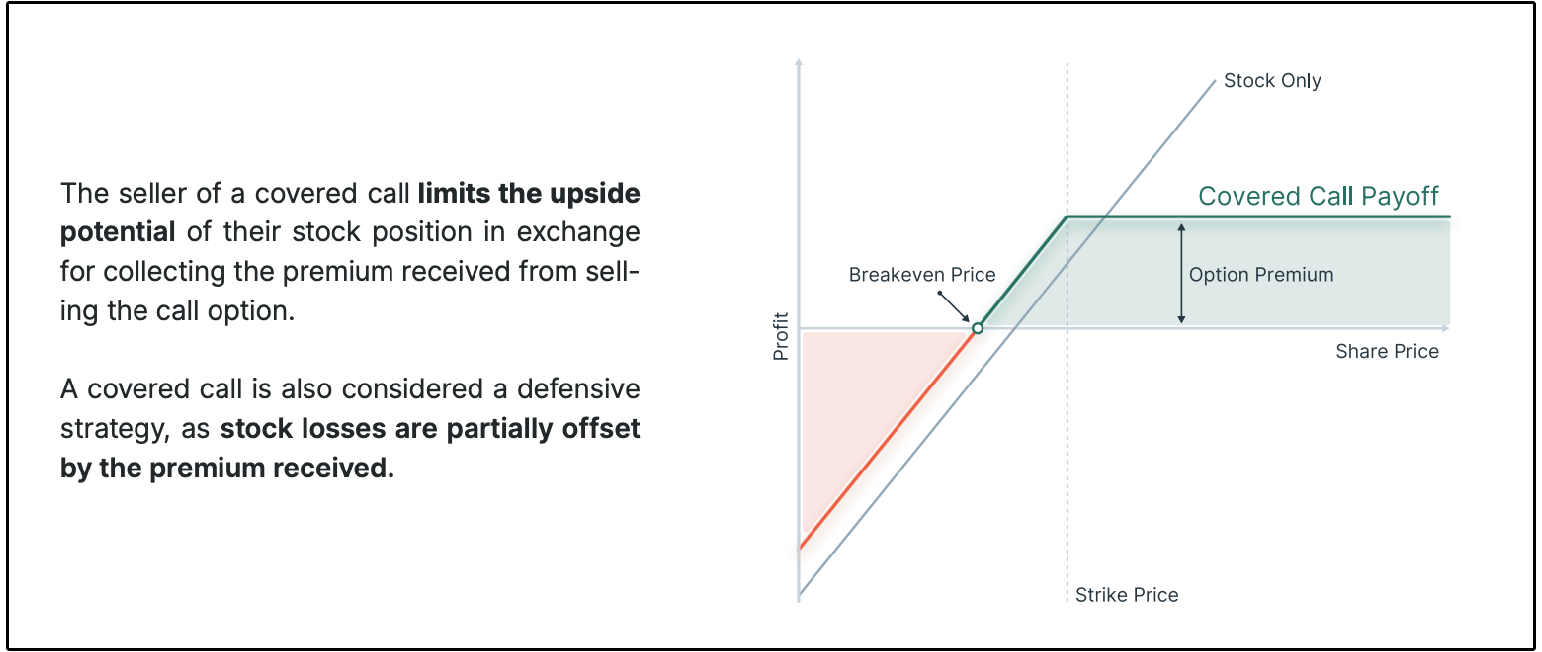
That premium is where the income comes from.
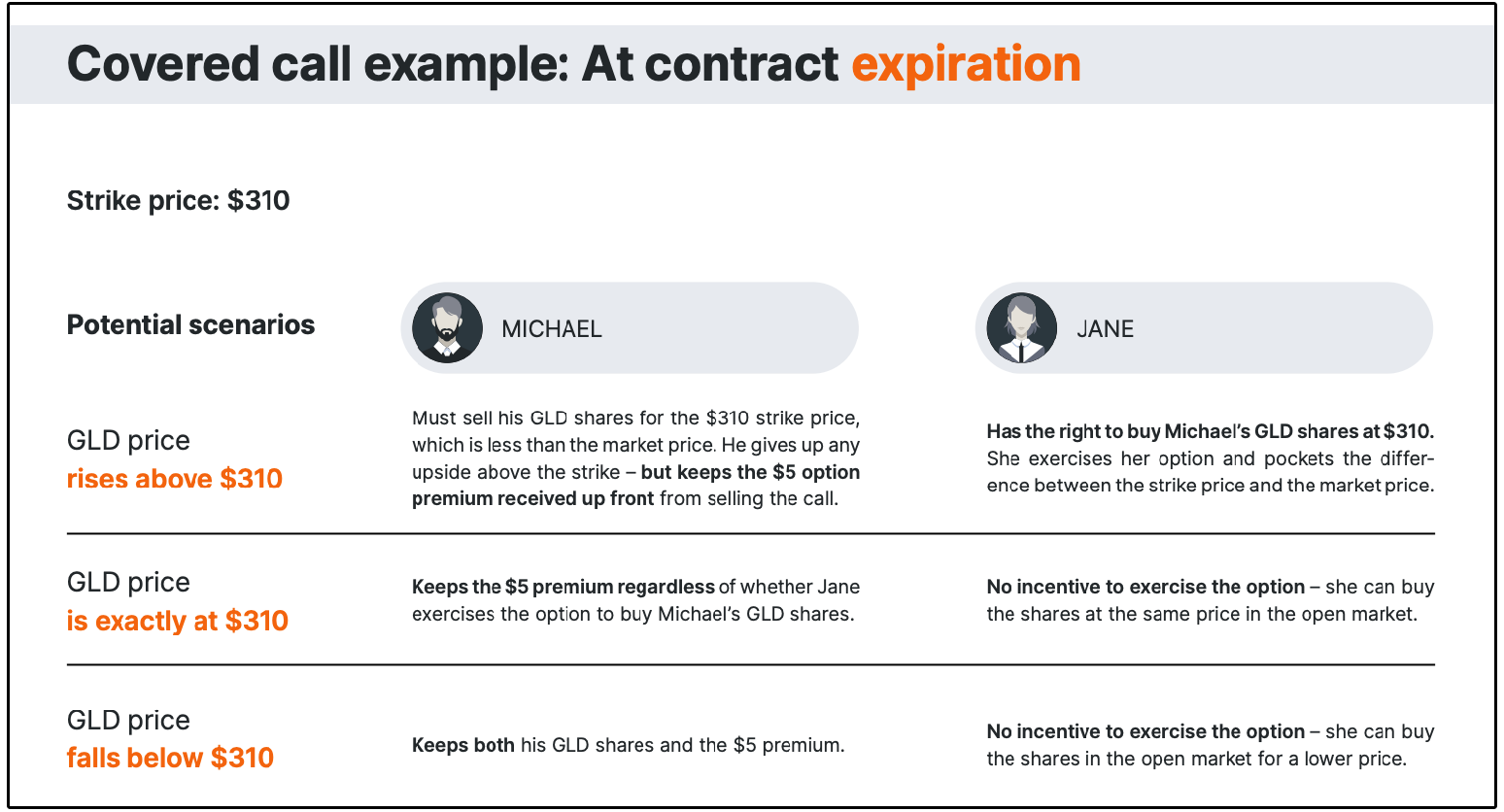
For example, imagine a gold-linked investment is trading at $300.
An investor owns the investment and sells a call option with a $310 strike price in exchange for a $5 premium.
From there, three basic outcomes are possible:
Covered calls tend to be most attractive in flat, choppy, or moderately rising markets.
To put it even more simply:
In a powerful bull market, the strategy may underperform the underlying asset because the sold calls limit some of the upside.
In a flat market, the strategy may outperform because it continues collecting premiums while the underlying asset goes nowhere.
In a declining market, the premium may allow the strategy to lose less than the asset itself. However, it can still experience meaningful losses because it retains exposure to the underlying investment.
For example, if gold remains range-bound for several months, repeatedly selling calls will produce income that would not exist from simply holding gold.
IncomeShares uses covered-call strategies for its Gold+ Yield and Silver+ Yield ETPs.
Beyond the type of options strategy used, three primary metrics affect how the fund operates.
Let’s review each of them.
📊 1. Portfolio Options Coverage
One of the most important metrics investors must know is portfolio options coverage.
Financial softwares don’t provide this data, so I’ve gone through ETF fact sheets to compile this data in the Dividendology Covered Call ETF Database.
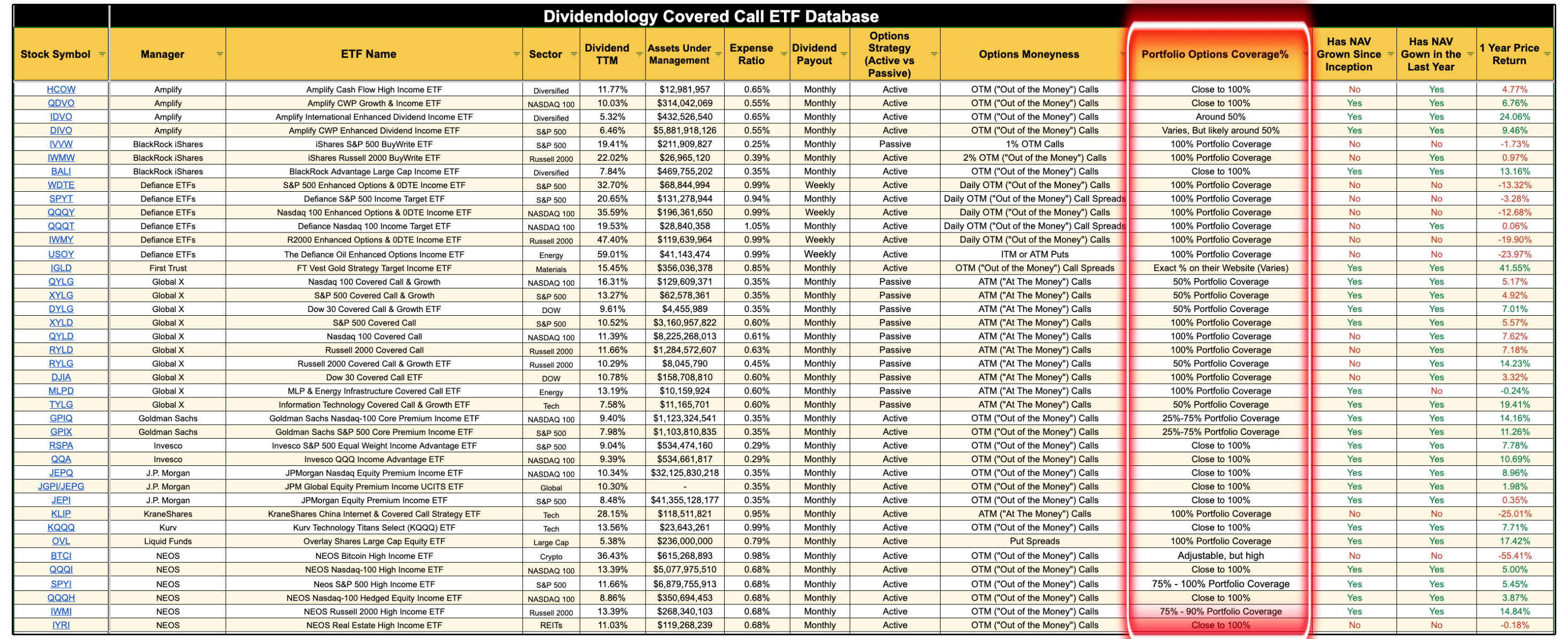
But why is this metric so important?
A strategy that writes options against a larger portion of its holdings can generally collect more premium income.
However, it may also retain less participation in the underlying asset’s upside.
A lower-coverage strategy typically generates less premium but allows investors to participate more fully if the asset appreciates.
This creates a sliding scale between income and growth.
The higher the portfolio’s options coverage, the more likely it is to have:
More immediate premium income
Less upside participation
On the flip side, less option coverage means:
Lower immediate income
More upside participation
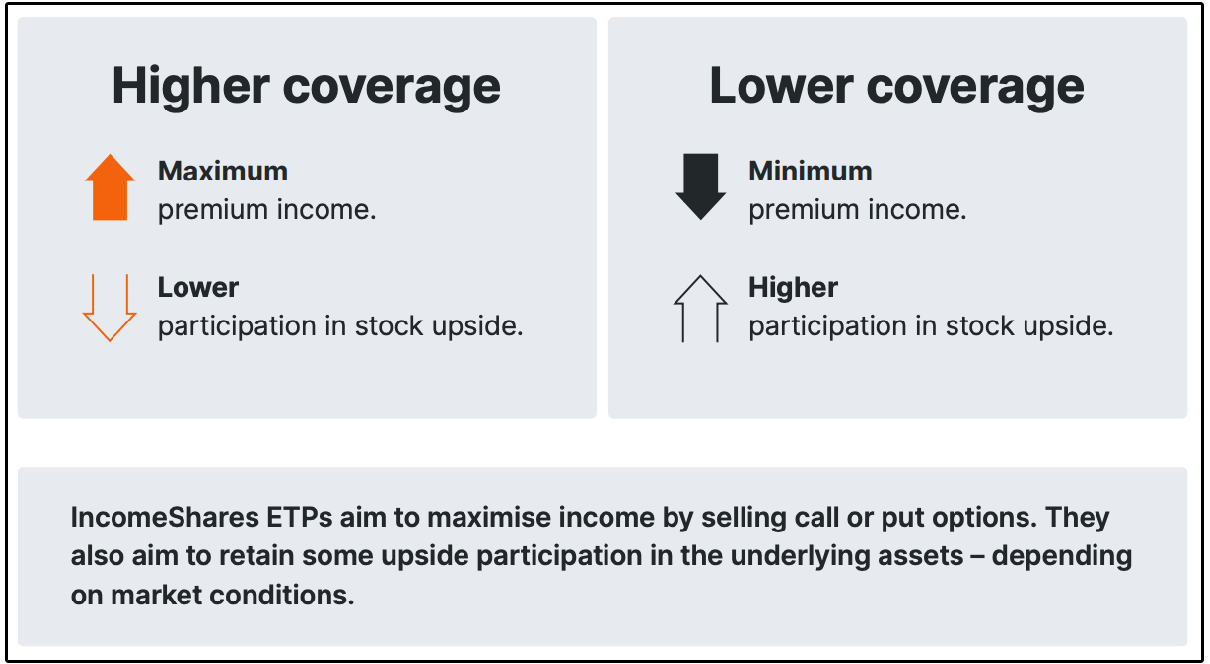
Two products tied to the same commodity can therefore deliver very different results depending on how aggressively they sell options.
⚡ 2. Volatility
Option premiums are heavily influenced by expected volatility.
Therefore, higher volatility typically equals larger distributions.
When the market expects an asset to make larger price moves, option buyers are generally willing to pay more for the possibility of benefiting from those moves.
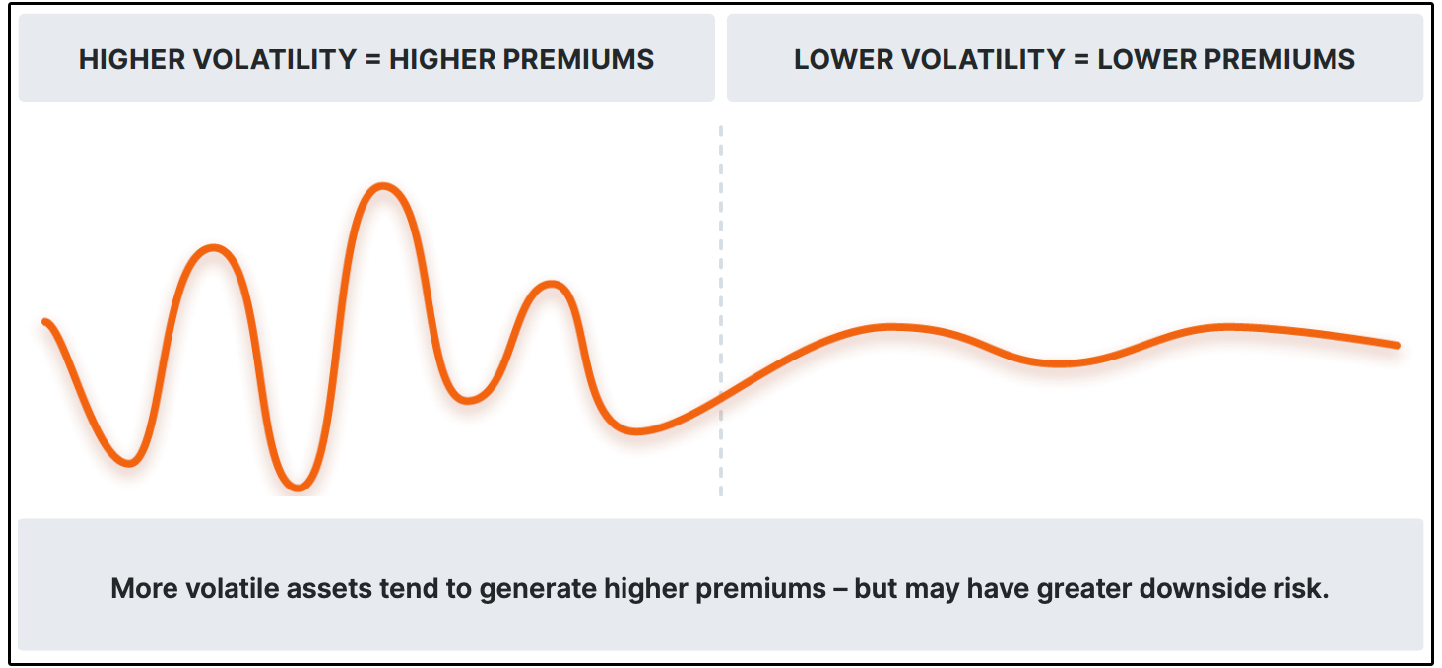
This helps explain why option-income products tied to volatile assets may advertise larger distribution rates.
The strategy can potentially collect more premium because the underlying asset is expected to move more dramatically.
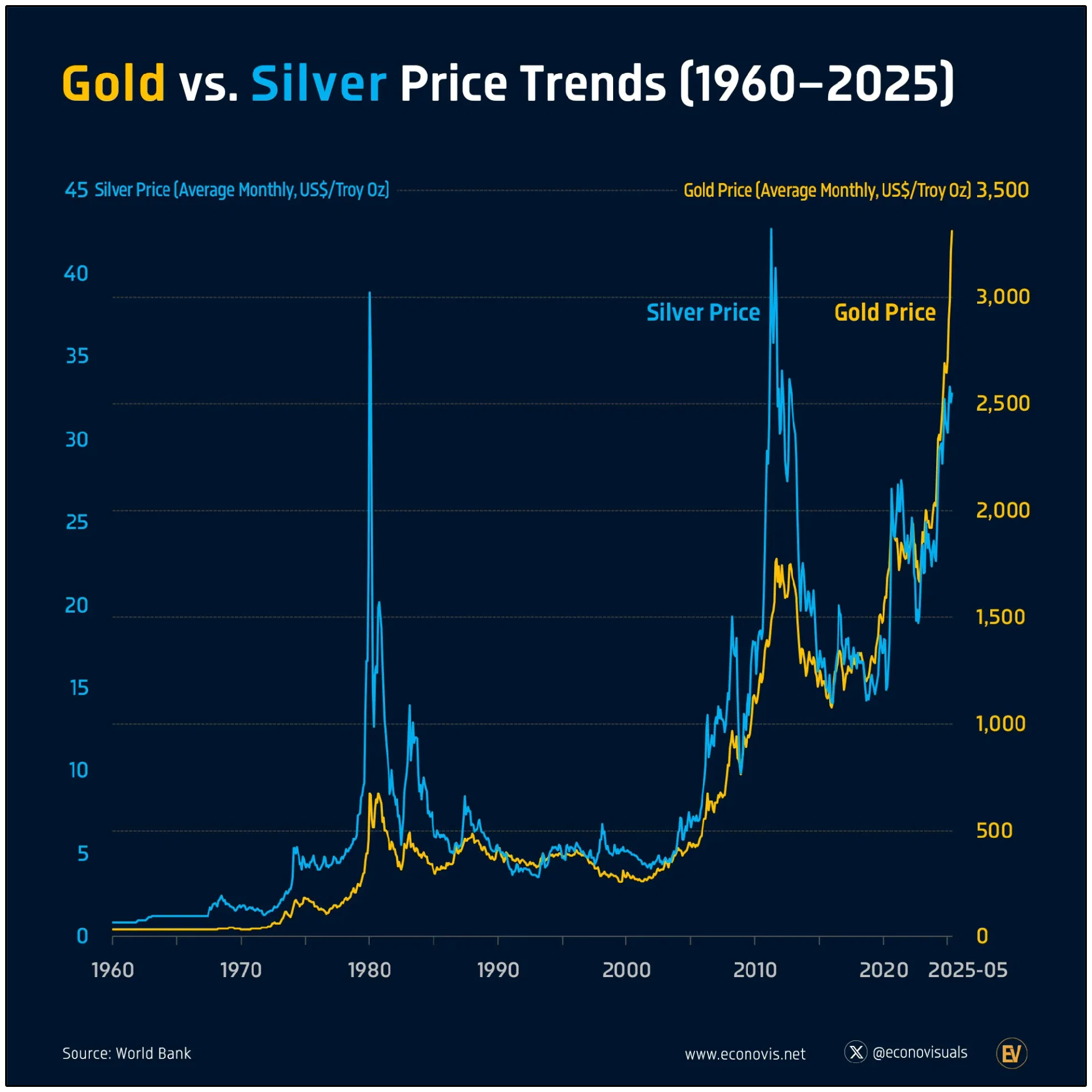
Gold will at times experience periods of relatively low volatility, while silver can experience much larger price swings.
🎯 3. Option Moneyness
The third important factor is option moneyness, which describes where the option’s strike price sits relative to the current price of the underlying asset.
For call options, there are three main categories:
Out of the money: The strike price is above the current market price.
At the money: The strike price is close to the current market price.
In the money: The strike price is below the current market price.
Why does this matter?
Because moneyness affects both the amount of income generated and how much upside the investor keeps.
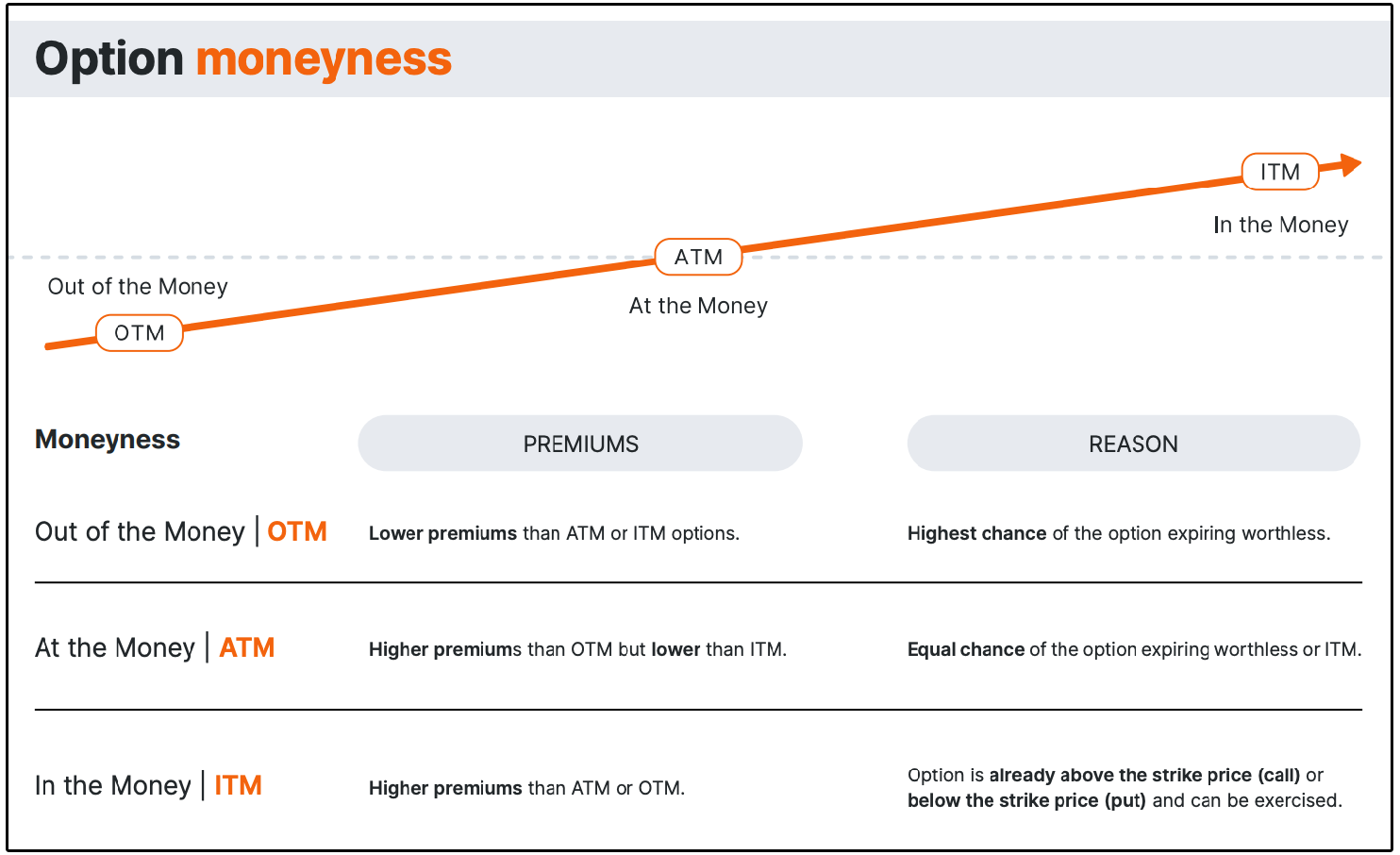
To put it simply:
More aggressive strike selection can create more income, but it usually comes at the cost of lower upside participation.
Less aggressive strike selection generally creates less income, but allows the investor to benefit more if the underlying asset rises.
Again, that means two covered-call products tied to the same commodity can have very different return profiles depending on whether they sell out-of-the-money, at-the-money, or in-the-money calls.
🌍 IncomeShares Commodity ETP Lineup
IncomeShares currently offers commodity option-income ETPs tied to copper miners, gold miners, gold, silver miners, silver, uranium, and WTI oil.
The Gold+ Yield and Silver+ Yield ETPs use covered-call strategies, while the other commodity products use a cash-secured put plus equity strategy.
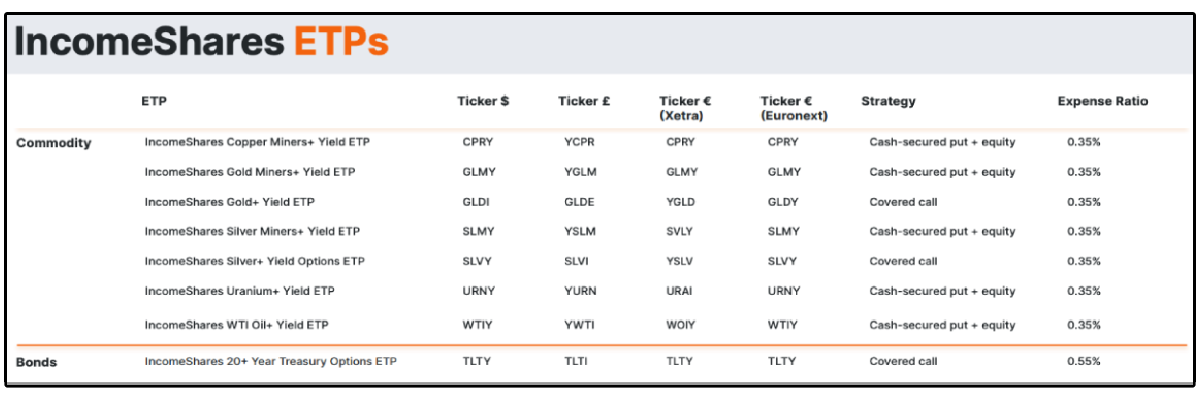
The main takeaway is that these products are not simply passive bets on commodity prices.
They combine commodity exposure with an options overlay designed to turn volatility into recurring income.
Many of their commodity ETPs currently have distribution yields near 12%.
🛠️ P.S. – I Have Something BIG For You…
Dividendology has become the largest dividend investing Substack newsletter in the world over the last year.
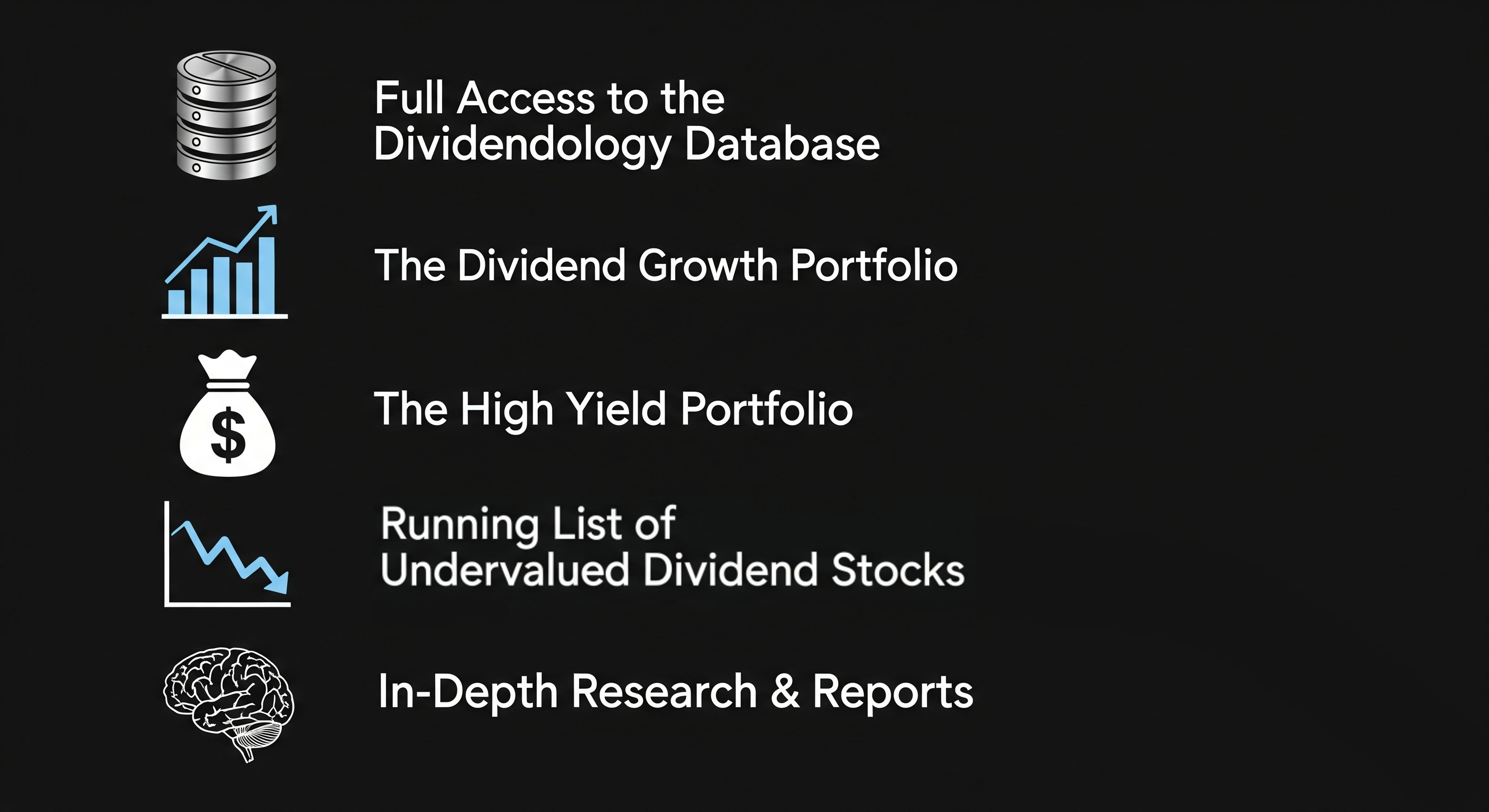
Members have gotten access to exclusive tools such as:
Covered Call ETF Database
Model Portfolios
REIT Database
BDC Database
Most Upside Dividend Stocks
However, I’m obsessed with providing as much value as possible.
That’s why I’ve been working on something in the background:
A Covered Call ETF database specifically for European investors, as well as expanding coverage of opportunities in European markets.
I believe this will provide tremendous value for European investors.
If you want to get access to this, as well as all the features mentioned below, you can do so here:
Stay tuned!
Dividendology
Check out these resources:
Tickerdata 🚀 (TICKERDATA SUMMER SALE (CODE: ‘HEAT’ FOR 30% OFF)
Interactive Brokers 💰 (My favorite place to buy and sell stocks all around the world!)
Seeking Alpha 🔥 (Research stocks $30 off! + 7 day free trial)
HYSA 📊 (Get Access to the Best High Yield Savings Accounts!)
AUM growth in covered call ETFs measures inflows, not outcomes. Capped upside plus tax drag on premium distributions means headline yield rarely equals total return. Realized total return data versus the index would tell the real story.
Commodity covered calls are an interesting twist since gold and silver volatility can spike sharply, so the premium collected in calm stretches may not offset the upside given away during a breakout.