

At the beginning of each month, I send out a spreadsheet that lists out the dividend stocks that I believe to be undervalued.
This is the end result of 100’s of hours of research every month.
It’s time to dive in.

1. 🛢️ MPLX (MPLX)
MPLX has now increased its quarterly distribution by 12.5% for three consecutive years!
Incredible distribution growth… But even more incredible considering that it’s current yield is 8.2%.
The Chowder Rule adds a stock’s dividend yield to its annual dividend growth rate to assess its combination of income and growth.
Using MPLX’s 8.2% yield and 12.5% distribution growth rate gives it a Chowder score of 20.7, comfortably above the commonly used 12-point target.
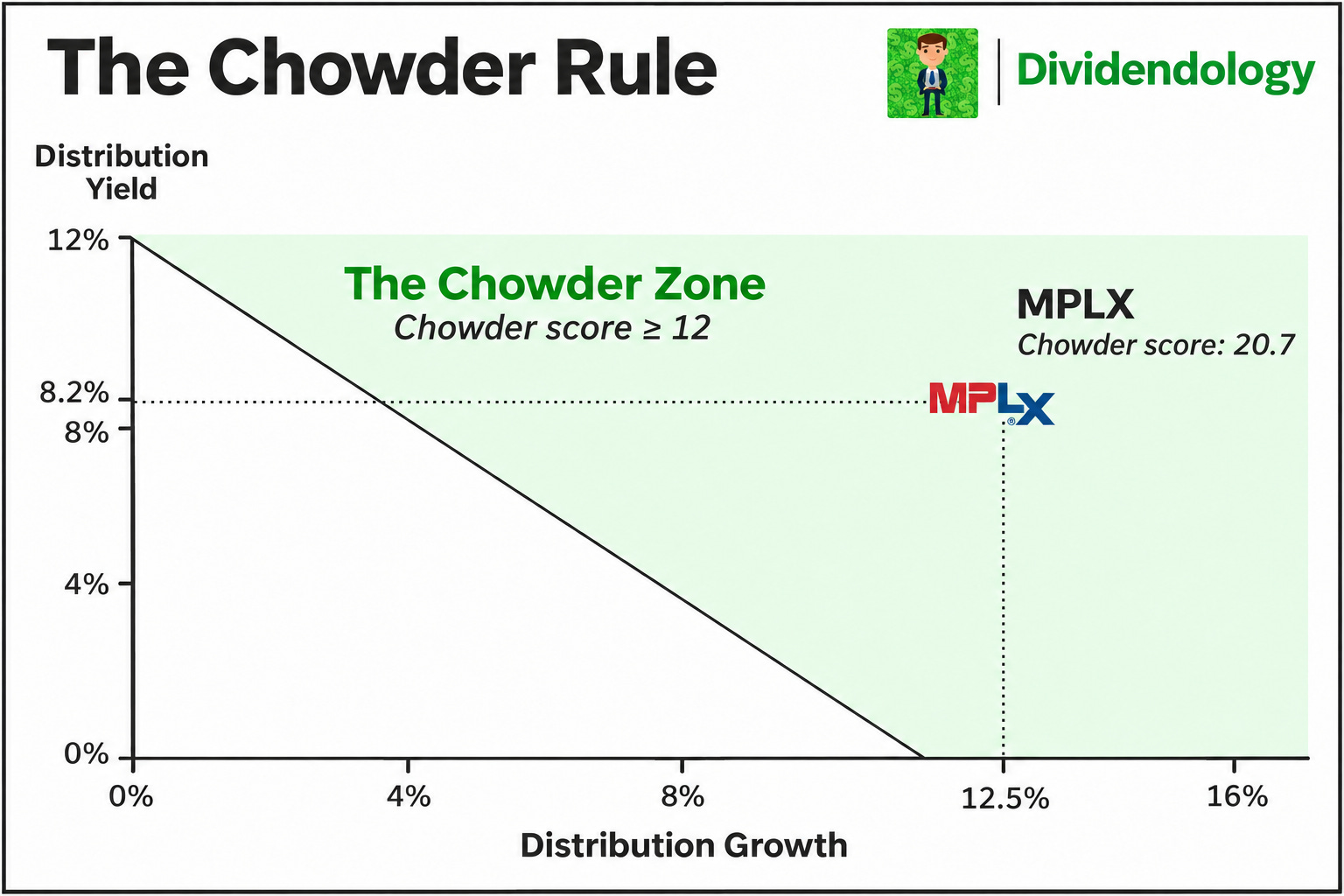
This gives them an astounding ‘Chowder Score’ of 20.7-
But understanding the business behind that income is important.
MPLX owns pipelines, storage terminals, natural-gas gathering and processing facilities, and infrastructure that separates natural gas liquids into usable products.
Customers primarily pay fees to move, store, and process energy products.
Long-term agreements with Marathon Petroleum include minimum-volume commitments and payments for reserved capacity-
Which makes cash flows FAR more predictable than those of an oil and gas producer.
Commodity prices still affect production activity and certain processing arrangements, but MPLX’s earnings are less directly dependent on the price of each barrel produced.
For businesses like this, growing distributable cash flow per unit is a primary driver of intrinsic value.
It supports the distributions investors receive, while retained cash can help fund growth and reduce debt.
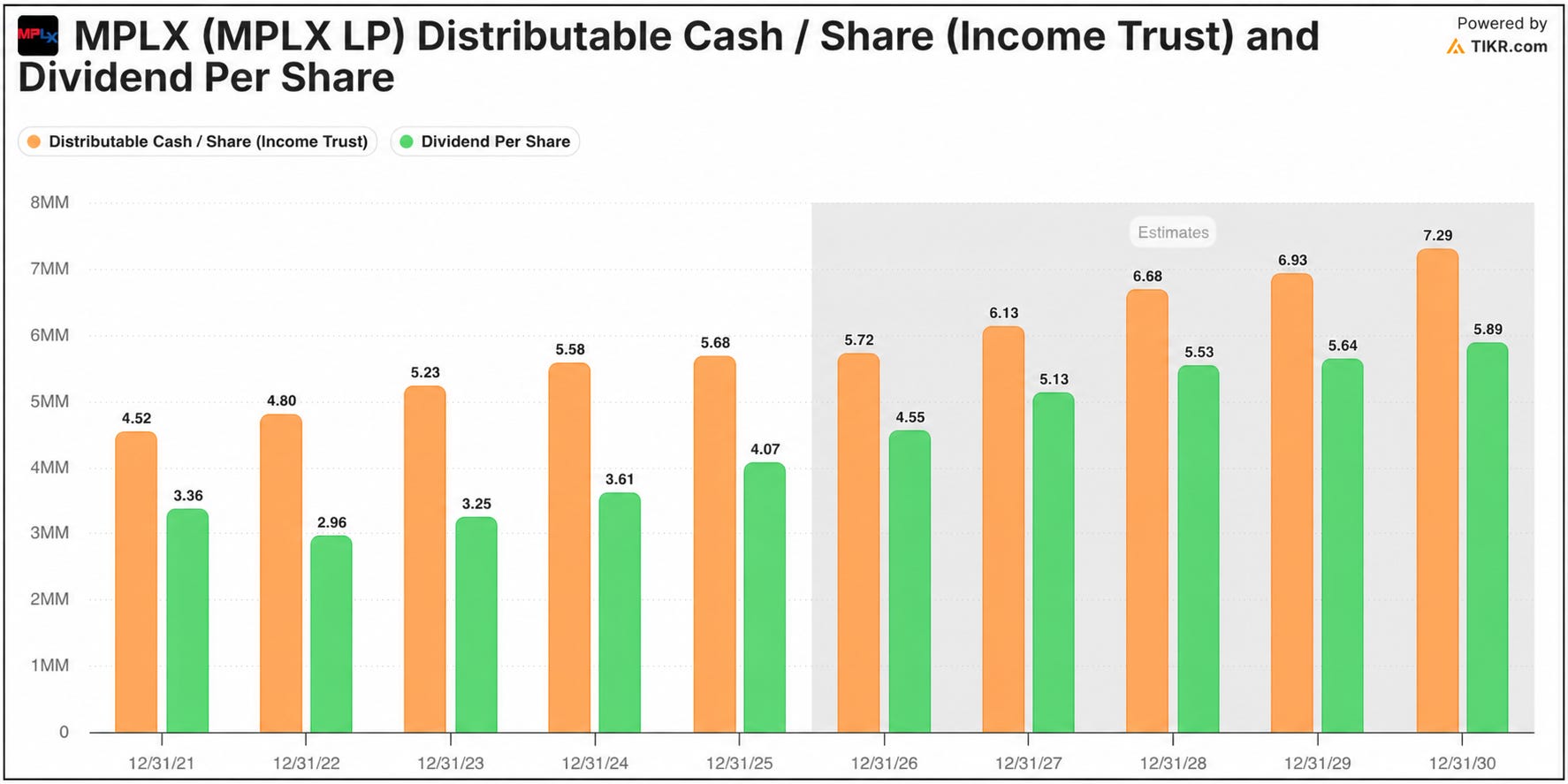
Distributable cash flows per share is still well covering the distributions-
But keep in mind that between 2023 and 2025, annual distributions increased from approximately $3.25 to $4.07 per unit, roughly 25%.
But distributable cash flow per share increased from approximately $5.23 to $5.68, roughly 9%.
Distributions grew faster than the cash flow supporting them, which does narrow the coverage cushion.
With that being said, they’re still sitting at a distribution coverage ratio of around 1.3x.
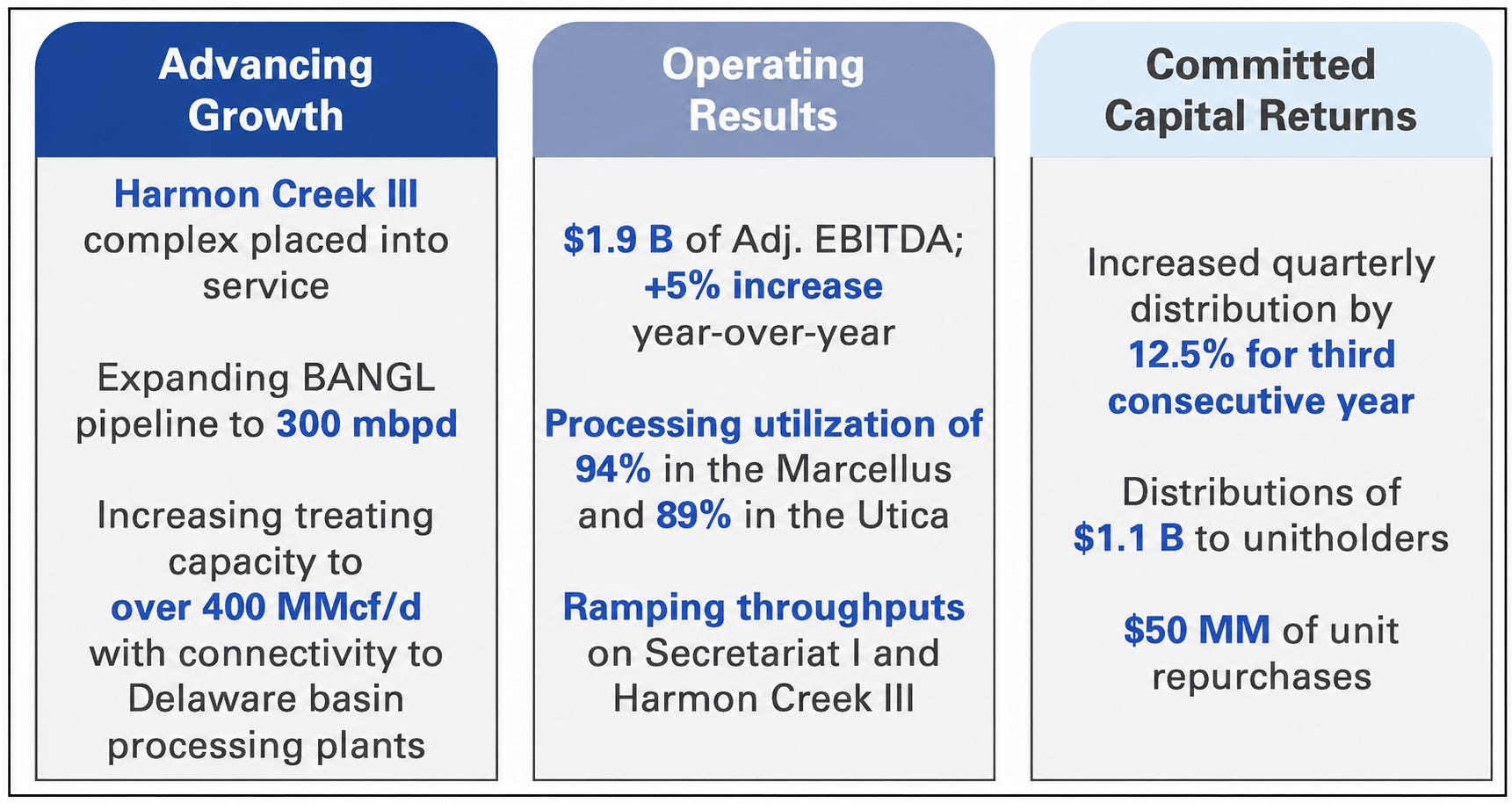
The payout remains covered, but maintaining 12.5% annual increases indefinitely would require stronger cash-flow growth.
Moving forward, I would expect lower distribution growth.
More than likely the distribution growth will be in line with EBITDA growth.
And keep in mind that debt has also grown faster than trailing adjusted EBITDA.
MPLX’s leverage ratio increased from 3.1 times at year-end 2024 to 3.8 times in September 2026.
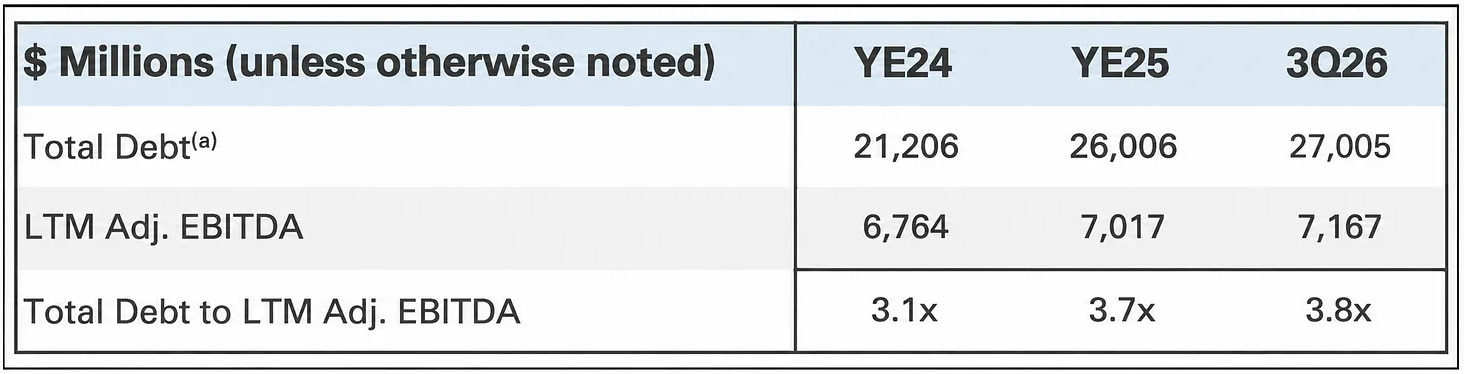
With that being said, the company still has very reasonable debt/leverage ratios.
Now, let’s compare MPLX with other large midstream businesses.
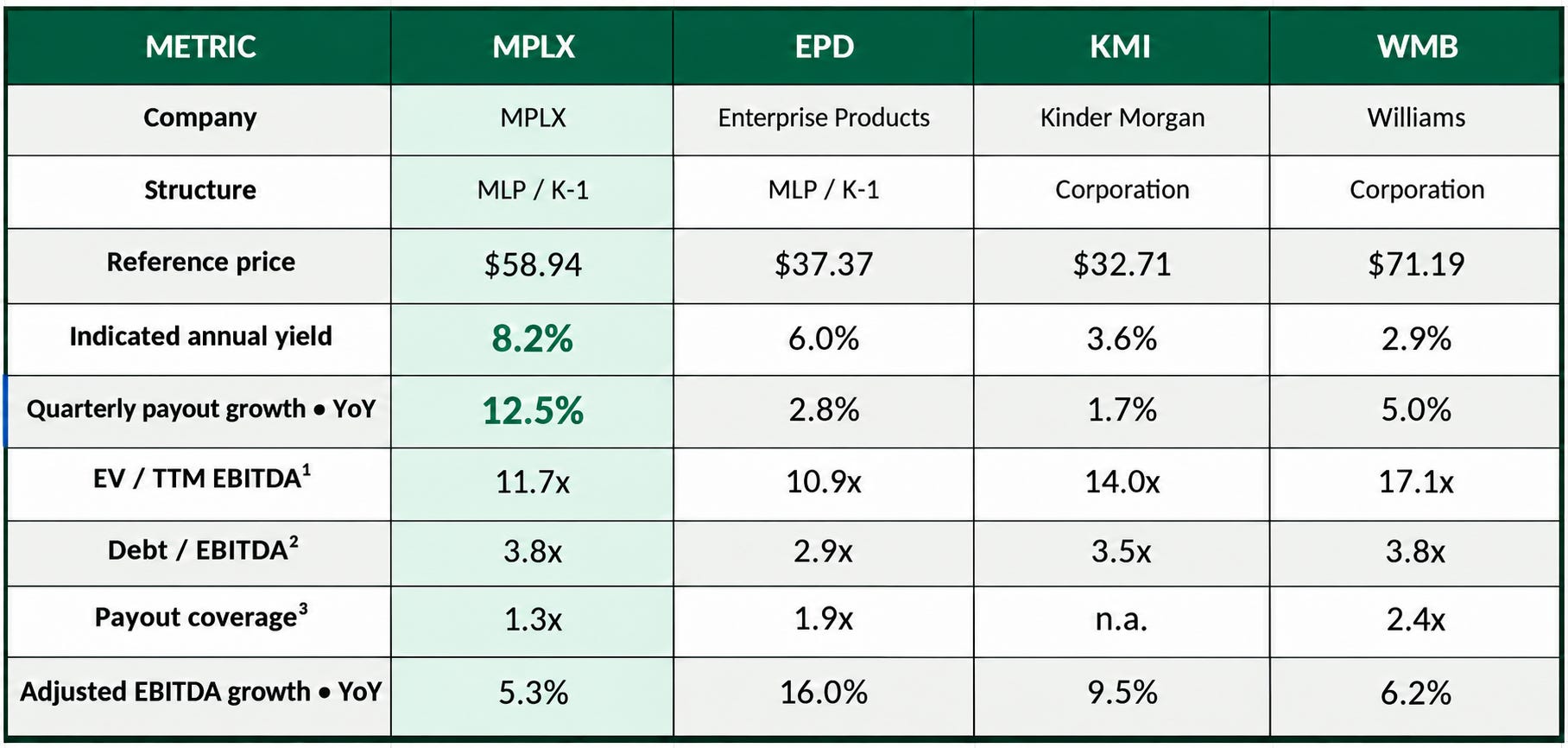
MPLX offers the highest starting yield and fastest recent payout growth in this group.
The valuation snapshot also places it approximately 16% below Kinder Morgan and 32% below Williams on EV/EBITDA.
EPD does trade at a lower multiple with better leverage ratios-
But the yield is lower with much slower distribution growth.
MPLX is attractive for investors seeking High Yield, but don’t expect the same level of distribution growth we’ve seen over the last 3 years.
2. 🚜 Caterpillar (CAT)
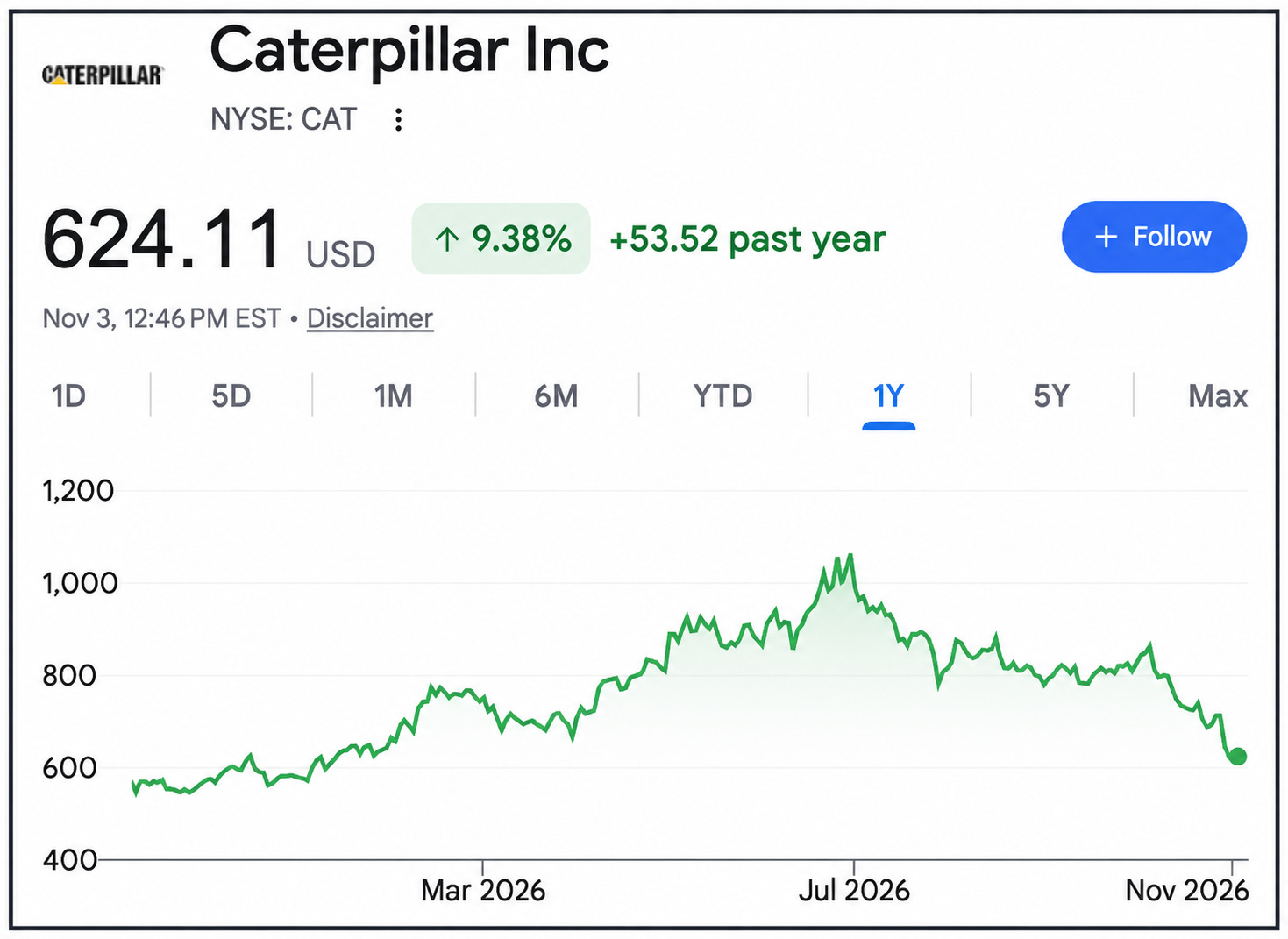
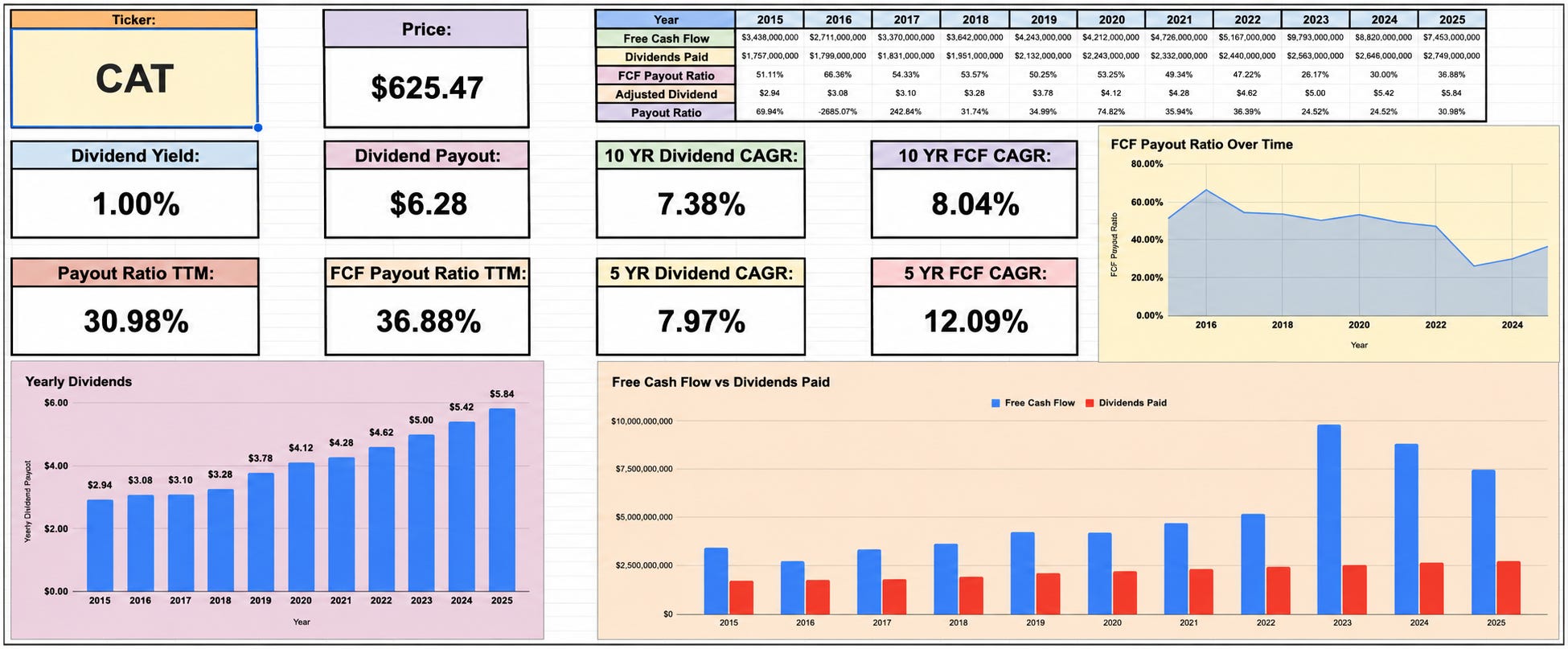
Caterpillar traded above $1,060 per share on June 30th.
Today, it’s trading around $590, a decline of nearly 50%.
Despite that massive pullback, the stock is still up approximately 9% in the last year and more than 200% over the last five years.
Of course a falling stock price doesn’t automatically make a business undervalued.
In fact, Caterpillar still trades at a premium to its historical valuation levels.
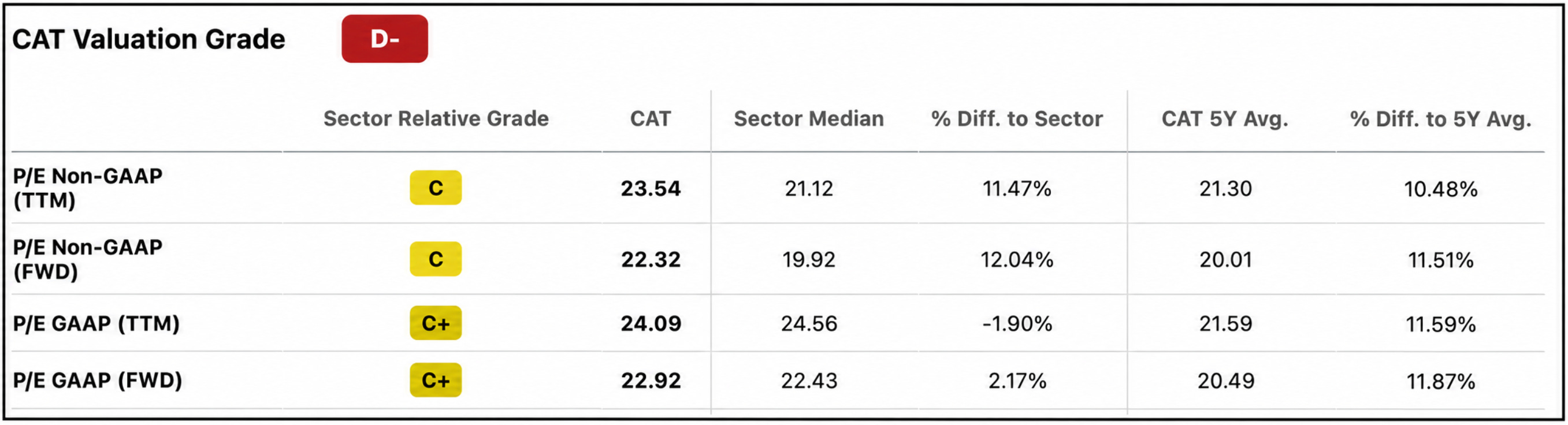
Right now they trade around 10%-11% higher than their typical P/E multiple levels-
But this can be justified if earnings are projected to grow at a much faster rate moving forward…
And they are.
CAT currently has a projected 3-5 YR EPS compounded annual growth rate of 18.33%.
This would put Caterpillar’s forward price-to-earnings-growth ratio at approximately:
22.32 ÷ 18.33 = 1.22 PEG
That makes the valuation much more interesting than the P/E multiple alone suggests.
And the one major reason investors expect stronger growth is something you might not immediately associate with Caterpillar:
Artificial intelligence.
Most people recognize Caterpillar for its yellow construction and mining equipment-
But its Power & Energy business supplies engines, generator sets, gas turbines, and related services.
Data centers need enormous amounts of electricity, along with reliable backup power to keep servers operating during outages.
CAT is set to benefit… And it already is.
This opportunity is already showing up in reported results.
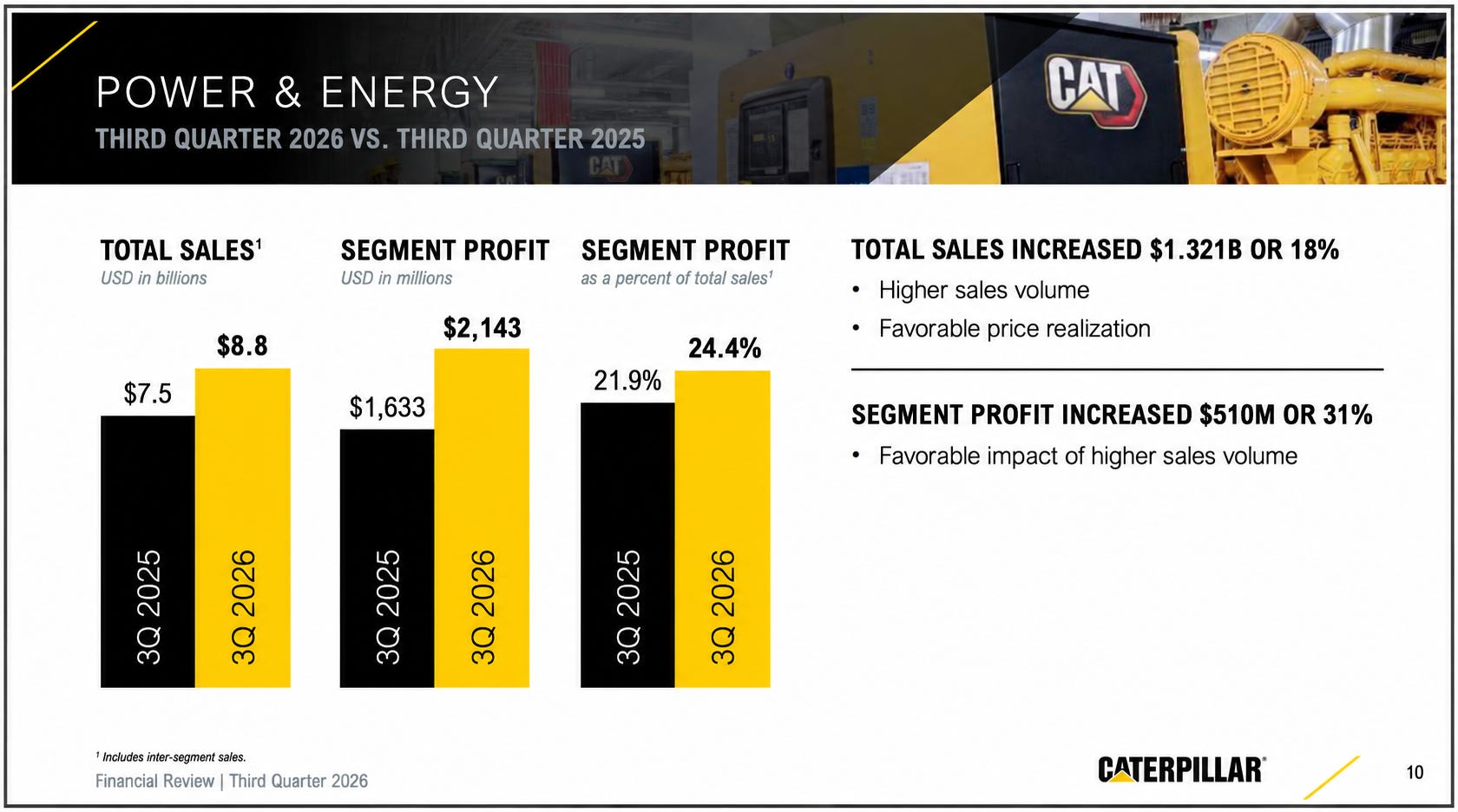
Third-quarter Power & Energy sales increased 18% to $8.8 billion, while segment profit increased 31%.
Management specifically identified large reciprocating engines used in data-center applications as a driver of power-generation sales growth.
Caterpillar doesn’t need to build the winning AI model to benefit from the infrastructure supporting it.
While this is the primary growth driver, their strength extends beyond that segment.
In the latest quarter, companywide revenue increased 17% to $20.7 billion.
Adjusted EPS increased from $4.95 to $7.20, roughly 45%, while adjusted operating margin expanded from 17.5% to 20.6%!
So why did the stock fall after reporting such strong earnings?
The results were strong, but the outlook fell short of investors expectations.
The risk of paying a premium valuation is you can get a drastic sell of when earnings don’t meet expectations.
However, The AI opportunity is still there and places the stock in a much more attractive valuation range.
And with earnings projected to grow at a substantial rate, it’s very possible we see higher levels of dividend growth moving forward from a stock that has already seen 33 consecutive years of higher annual dividends.
Using the average analyst estimate of approximately $46.33 in EPS for 2029, we can model what a lower valuation multiple would imply:
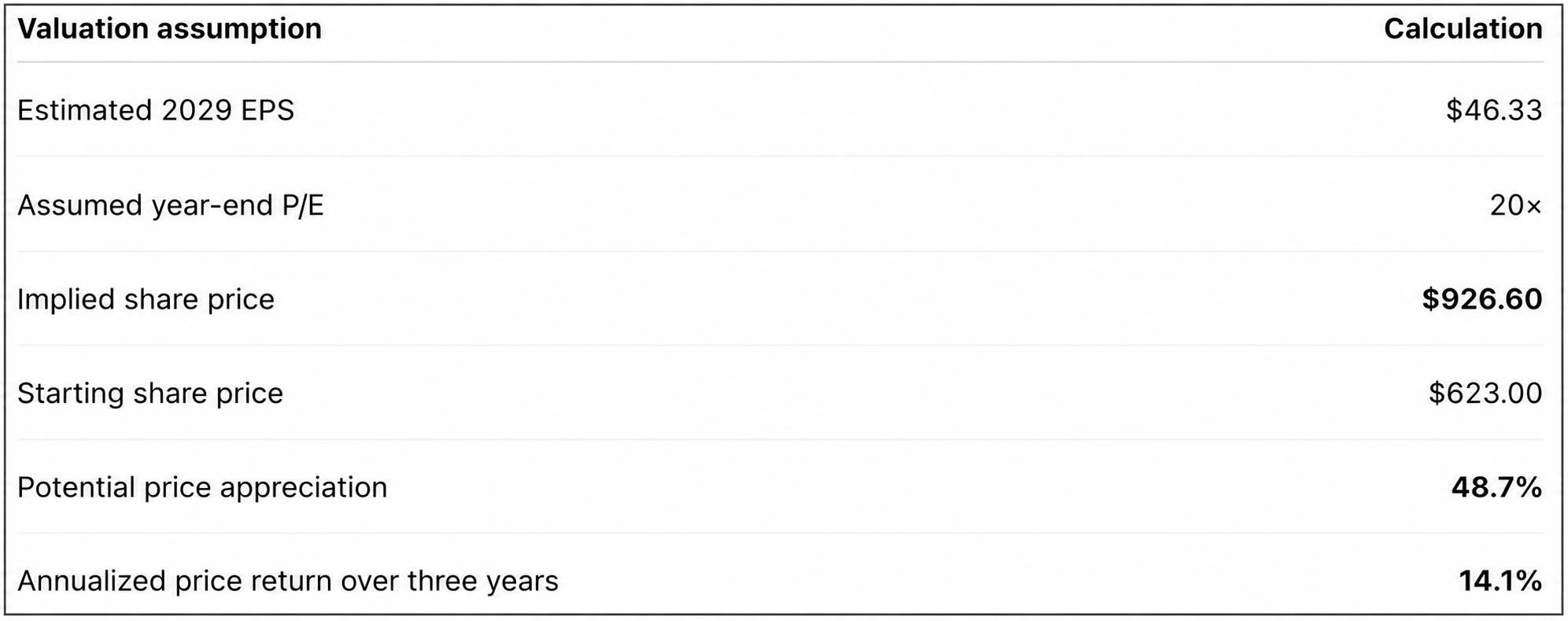
An annualized price return over 3 years of 14.1%, along with a growing dividend is attractive.
The stock would not need to return to its June price levels to produce an attractive return.
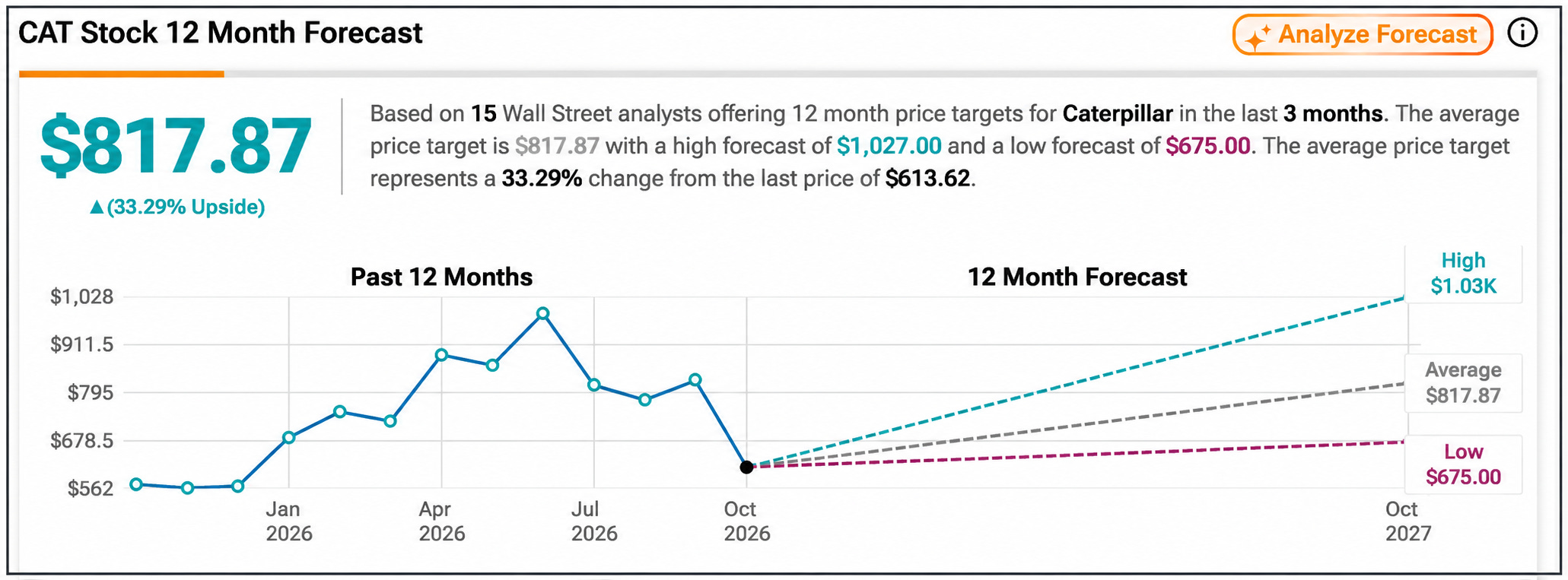
Looking at this modeled out also reveals why the average analyst price target is implying 33% upside form current levels.
The risk is that data-center spending slows, projects are delayed, or weakness in construction and mining offsets power-equipment demand-
But after the recent selloff, Caterpillar offers a more interesting entry point into a growing power-infrastructure business with an established dividend-growth record.
3. 🏢 Alpine Income Property Trust (PINE)
PINE is a REIT that currently offers a starting dividend yield of approximately 7.57%-
With a payout ratio of just around 58%.
That’s a very healthy payout ratio for a high yielder (especially a REIT).

Alpine Income Property Trust owns commercial properties leased to individual tenants under long-term net leases.
Tenants generally cover property taxes, insurance and maintenance, which makes the cash flows for PINE far more predictable.
PINE owns 130 properties across 31 states, with 99.6% occupancy and an average remaining lease term of 8.7 years.
Investment-grade tenants represented 56% of annualized base rent.
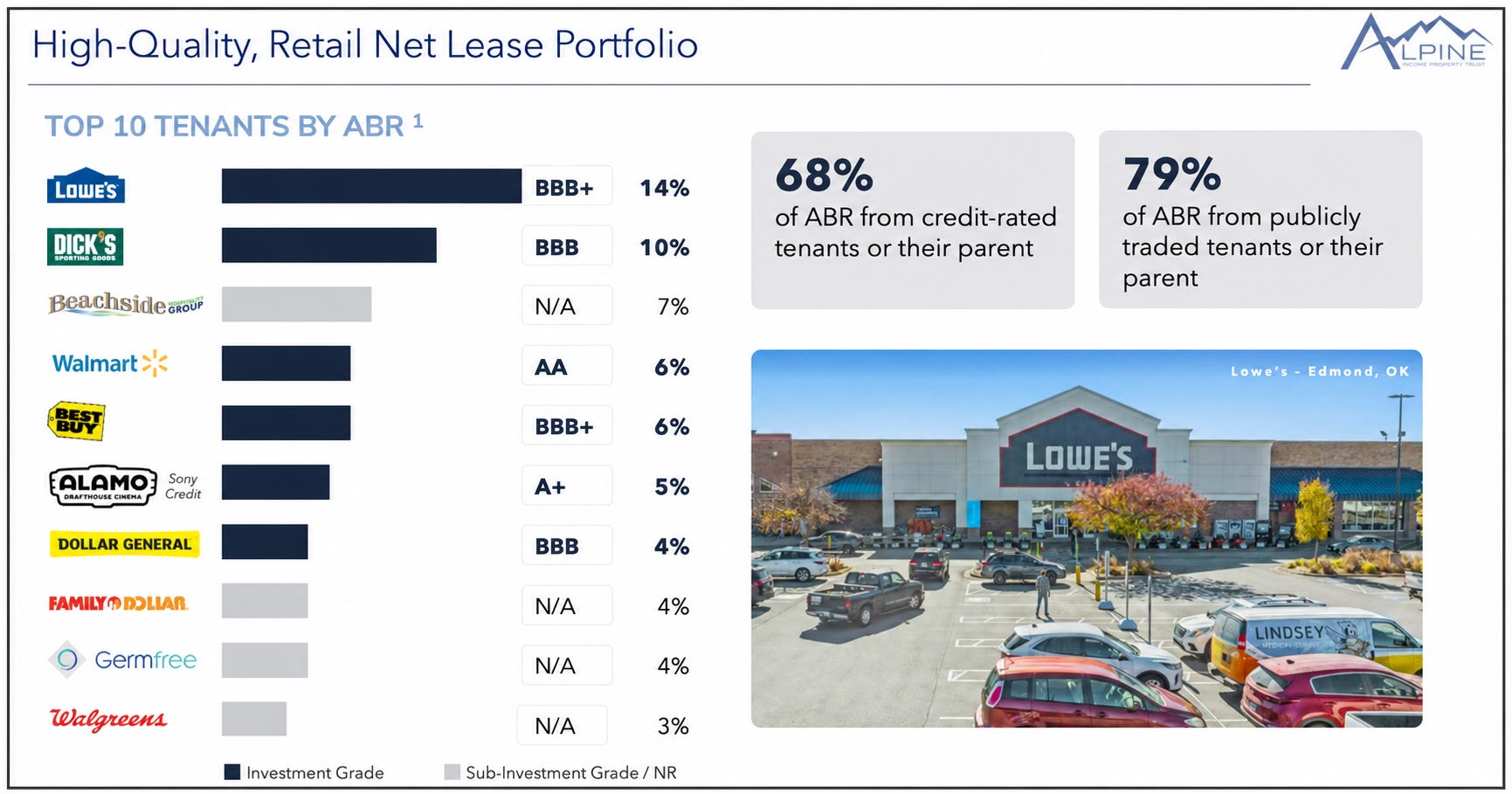
The portfolio includes familiar names like Lowe’s, Dick’s Sporting Goods, Walmart and Best Buy.
With that being said, there is some tenant concentration.
Lowe’s and Dick’s alone represented approximately 24% of annualized base rent.
These are quality tenants, but it is worth noting.
The underlying earnings have continued growing despite the recent sell-off.
With that being said-
Third-quarter AFFO per share increased from $0.46 to $0.55, approximately 20%. Management also raised full-year AFFO guidance to $2.20–$2.22 per share.
At the midpoint, that represents approximately 17% growth over 2025’s $1.89 per share.
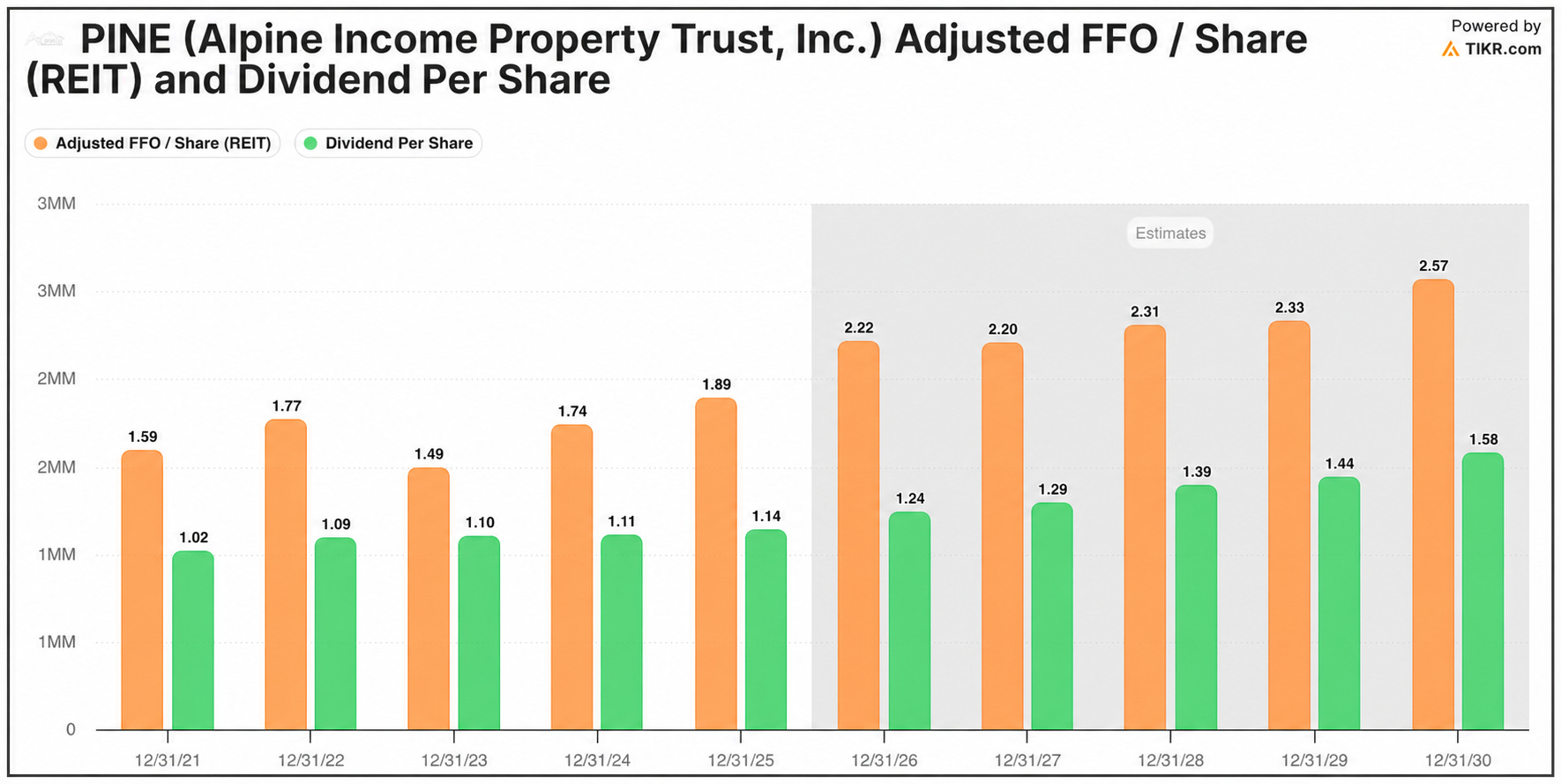
But I wouldn’t extrapolate this year’s earnings growth indefinitely.
The analyst estimates shown above actually anticipate roughly flat AFFO per share in 2027 before growth resumes.
PINE also carries risks that help explain its discounted valuation, with the REIT trading at just 7.69x AFFO per share.
Net debt to pro forma adjusted EBITDA currently sits 6.5 times.
In most circumstances we would like to see this no higher than 5.5x.
Its commercial loan portfolio had approximately $160 million outstanding, with an average coupon of 13.4%, including paid-in-kind interest.
Those loans do generate attractive income-
But they also introduce borrower, development and repayment risk.
Paid-in-kind interest also means some reported income accrues before cash is collected.
Financing costs, leverage and lending exposure help explain why investors are reluctant to pay a higher multiple.
And of course, climbing Treasury rates have contributed to the sell off for essentially all REITs.
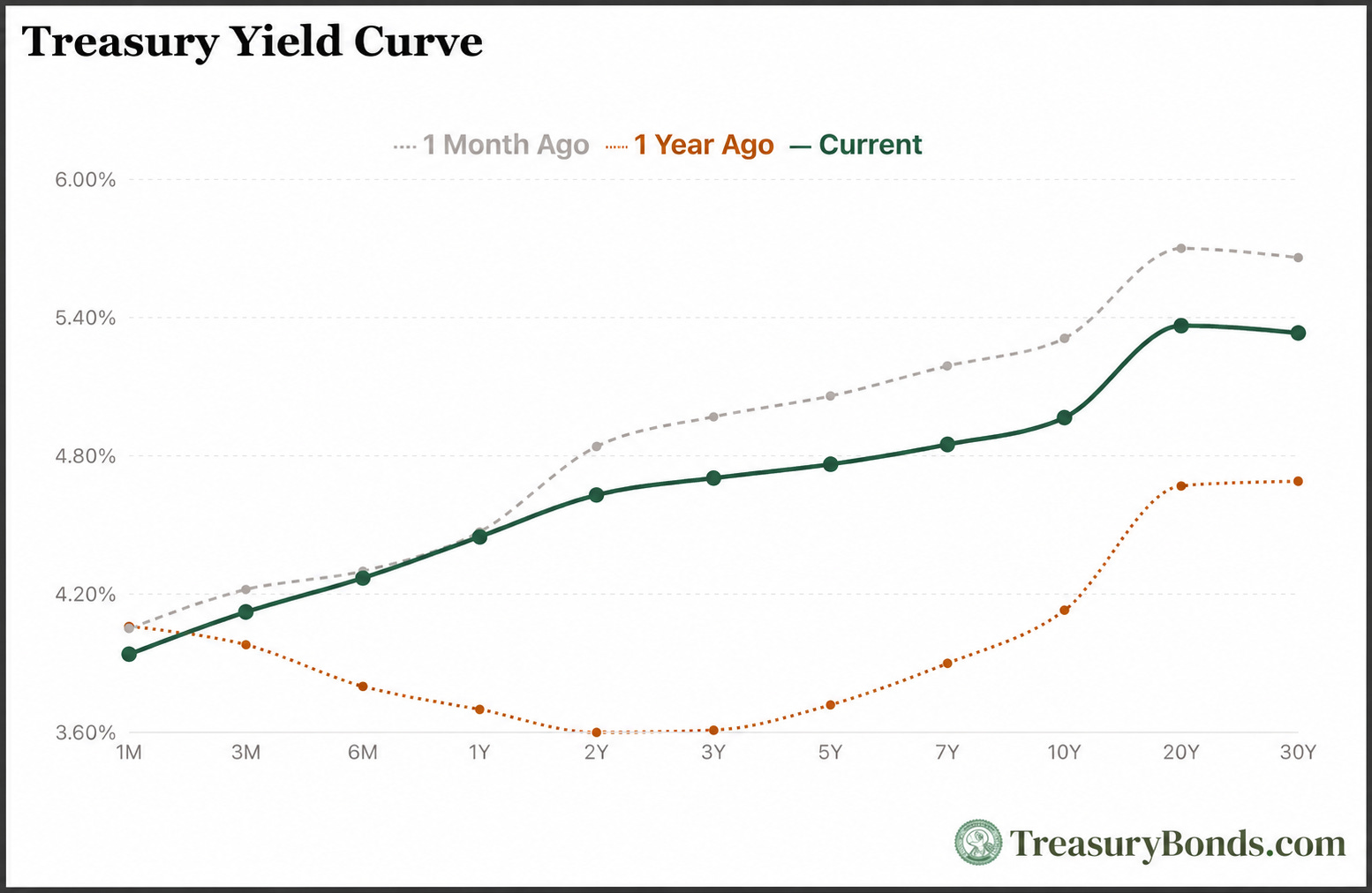
On top of this, the balance sheet is still changing.
On November 2nd, PINE completed a $117.3 million industrial portfolio acquisition funded through its revolving credit facility.
The reported 6.5-times leverage ratio predates that transaction.
This gives them more leverage relative to their peers.
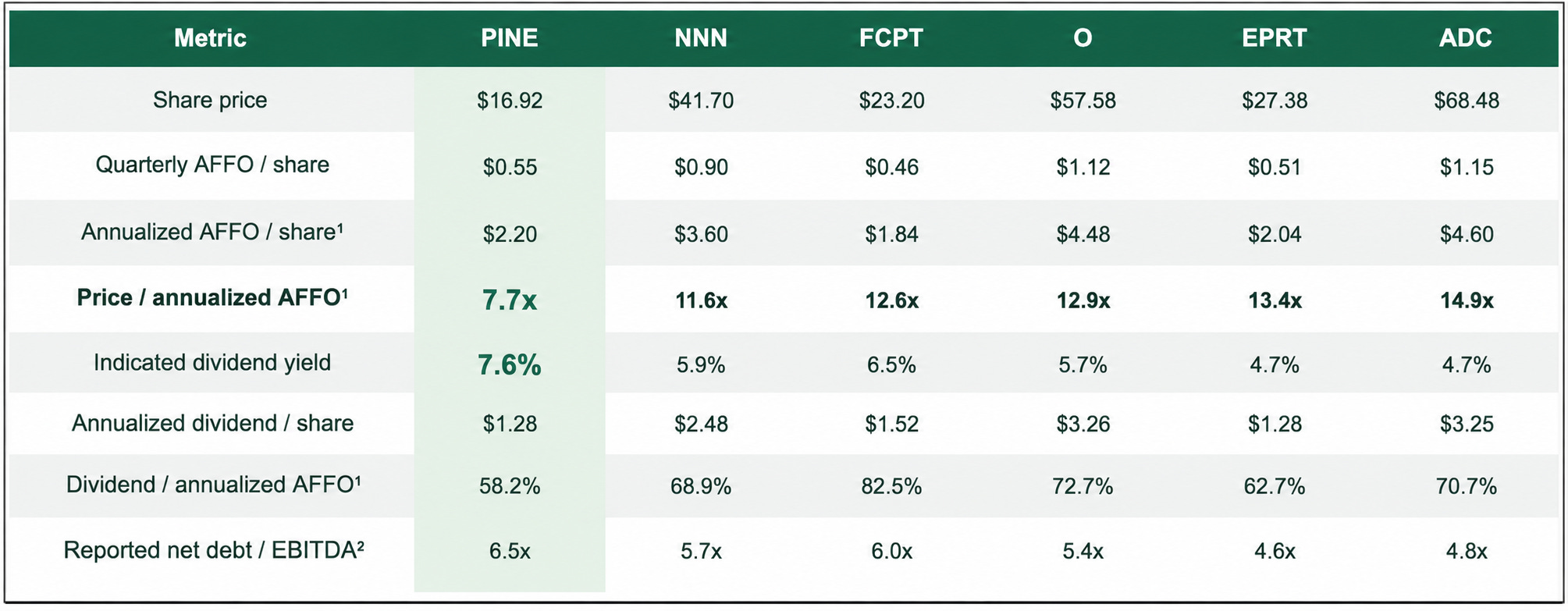
Even allowing for those differences, the valuation looks unusually low.
PINE trades around 7.7 times, compared with approximately 11.6–14.9 times for NNN, FCPT, Realty Income, Essential Properties and Agree Realty.
PINE certainly does deserves a discount…
But it doesn’t need to command a premium multiple for investors to benefit.
For example, applying just 9 times the $2.21 guidance midpoint produces a value of approximately $19.89 per share, around 18% above the $16.92 share price, before dividends.
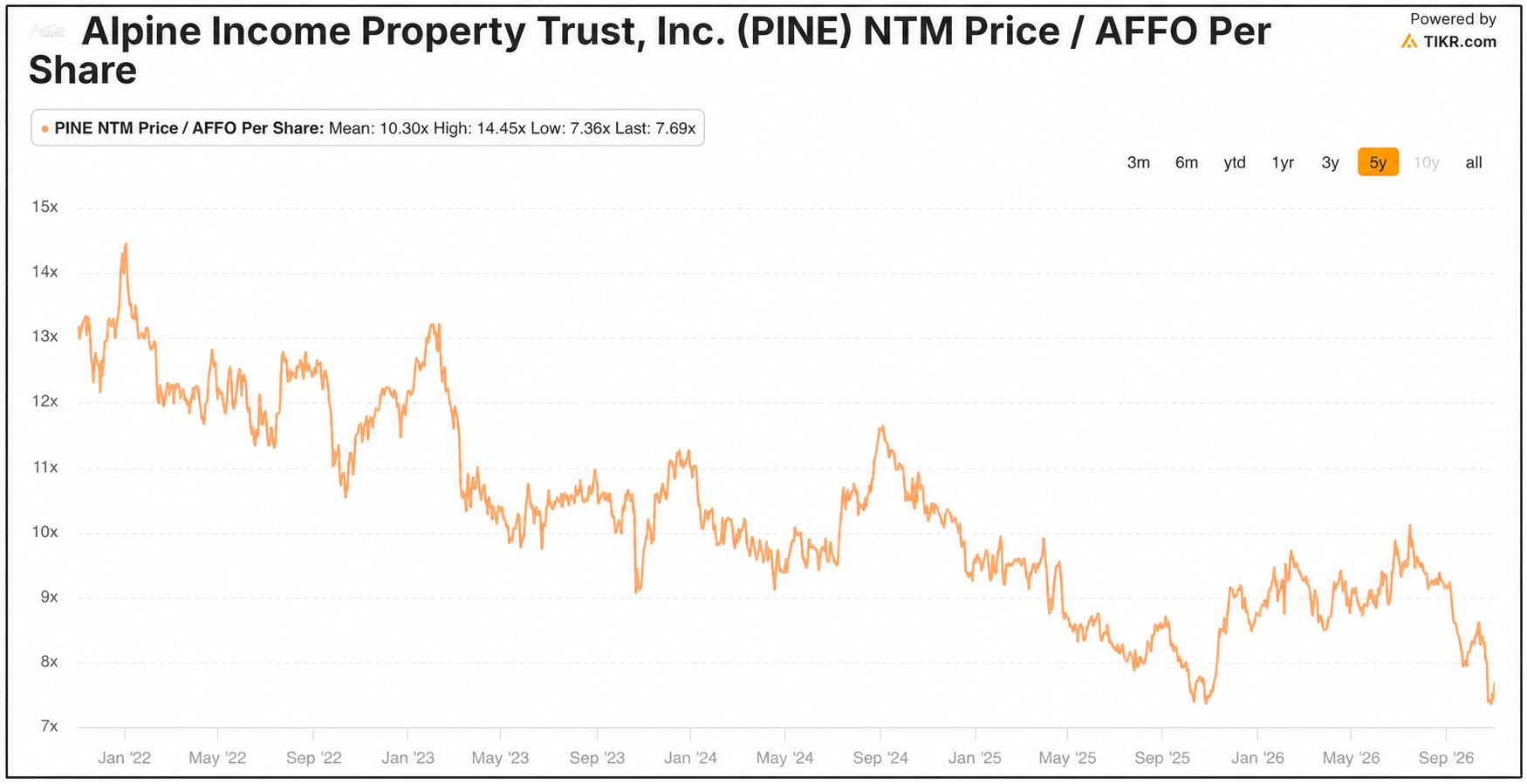
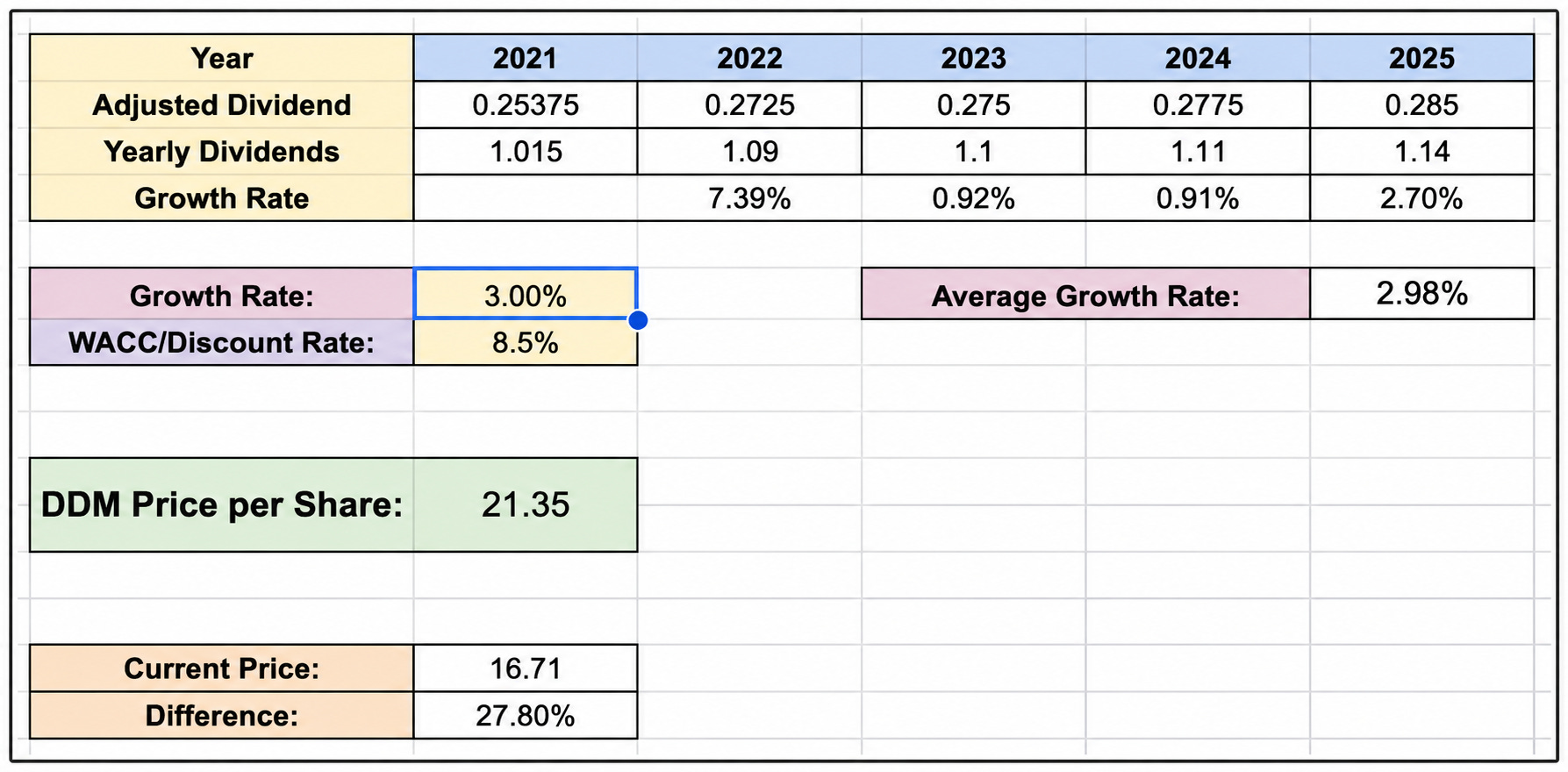
The dividend discount model offers another perspective.
Even retaining the older $1.14 annual dividend, 3% perpetual dividend growth and an 8.5% required return produce a value of approximately $21.35.
That implies the screenshot’s 27.8% upside from $16.71.
If you are an investor looking for safe high yields, PINE’s 8% Series A cumulative preferred shares are another option near their $25 liquidation preference.
Third-quarter AFFO before preferred dividends covered the preferred payout approximately 9.4 times, or 8.6 times AFTER subtracting reported PIK interest.
PINE’s appeal is the combination of substantial income, strong reported dividend coverage and a valuation that leaves room for its added risks.
Now, let’s review the full list for November.