

At the beginning of each month, I send out a spreadsheet that lists out the dividend stocks that I believe to be undervalued.
This is the end result of 100’s of hours of research every month.
It’s time to dive in.

1. 🌿 Innovative Industrial Properties (IIPR.PR.A)
Innovative Industrial Properties (IIPR) is a specialized REIT that owns cultivation and processing facilities leased to licensed cannabis operators across the United States.
The common stock still offers a very high yield, sitting at roughly 13.3%.
However, I’m not interested in the common stock here.
I’m far more interested in the preferred shares.

IIPR’s 9.00% Series A cumulative preferred shares currently offer a yield of roughly 9%, which is already attractive on its own.
But what makes it so attractive relative to the common stock is that the risk to reward is quite attractive.
The income from the preferred shares is backed by one of the more conservative balance sheets in the REIT sector.
IIPR ended the latest quarter at just 1.7x net debt to adjusted EBITDA, while the preferred dividend is covered roughly 16.6x by annualized AFFO.
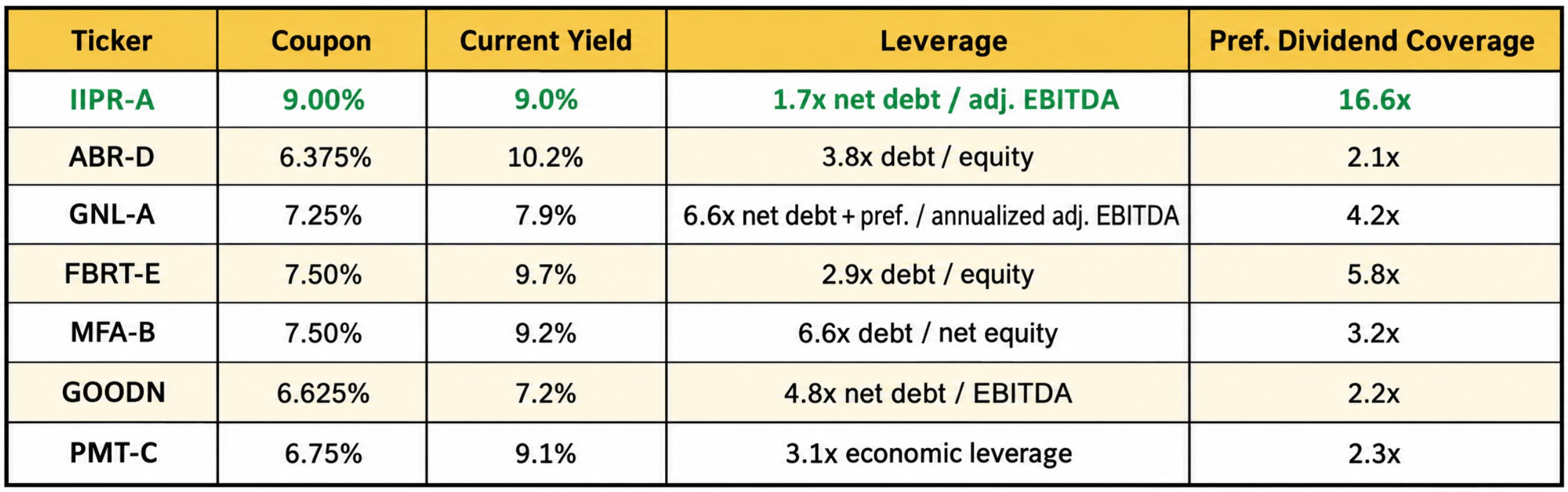
That coverage ratio is lower than it was previously because IIPR has issued a significant amount of additional preferred stock, but it is still exceptionally strong-
And especially strong relative to the preferred stock of their peers.
That means the preferred dividend still has a very large cushion before it would come under meaningful pressure.
There have also been some encouraging developments on the tenant side.
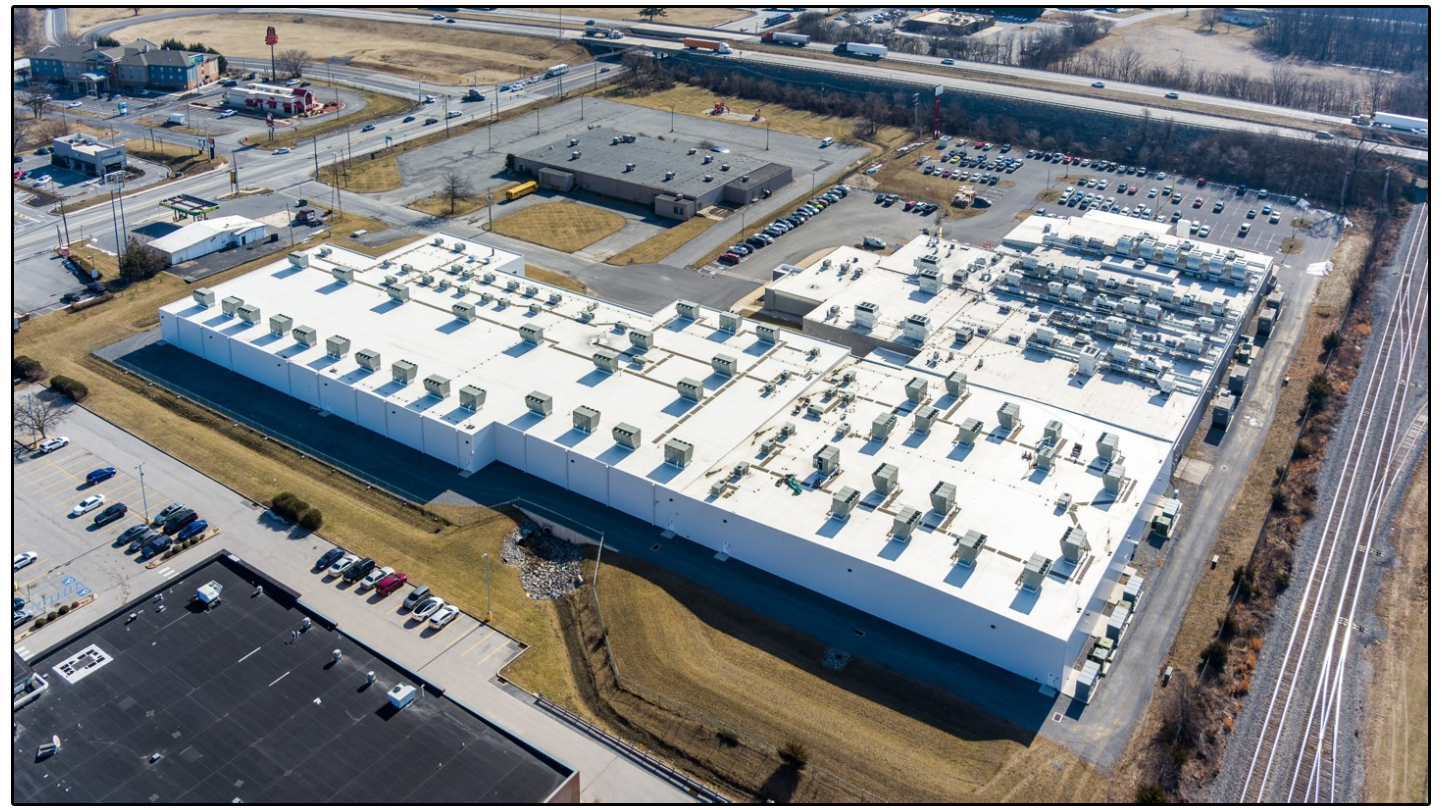
One of the biggest recent updates involves the former PharmaCann facility in Hamptonburgh, New York, which was re-leased to Grown Rogue.
The PharmaCann facility had been one of the problem tenants investors were watching closely.
Re-leasing the property does not eliminate tenant risk across the portfolio, but it does show that IIPR has been making real progress repositioning troubled assets and replacing distressed operators with new tenants.
There was also an important new update on the preferred shares themselves from just earlier this month.
On September 1, 2026, IIPR filed an 8-K updating its at-the-market equity program.
The program continues to allow IIPR to sell both common shares and its 9.00% Series A preferred shares, with as much as $500 million of aggregate offering capacity.
IIPR is still actively preserving the ability to issue more of the 9% preferred stock.
Keep in mind, the preferred is already callable at $25.
If management were preparing to redeem the security in the near future, it would be somewhat unusual for the company to simultaneously maintain an active mechanism allowing it to issue even more shares of the same preferred.
In my view, this makes an imminent redemption look less likely, which is good news for those of us who want to collect the high yield.
The trade-off, of course, is that every additional preferred share increases IIPR’s fixed dividend obligation.
So if management continues issuing preferred stock aggressively, the preferred dividend coverage ratio will gradually come down.
This is something I will continue watching closely.
For now, though, the cushion remains substantial.
Based on the latest quarter, the preferred dividend is still covered roughly 16.6x by annualized AFFO, while leverage remains just 1.7x net debt to adjusted EBITDA.
And importantly, there has been no new preferred dividend reduction, call or redemption announcement, or major new tenant default.
So the thesis remains largely intact.
The cannabis industry remains volatile, and yes, IIPR still has tenant credit risk, and continued preferred issuance could eventually reduce the margin of safety.
But investors are still collecting around 9% annual income from a cumulative preferred security backed by a very lightly leveraged REIT with strong dividend coverage, while recent tenant developments are moving in the right direction.
The September ATM update actually strengthens one part of the thesis:
Management’s willingness to continue issuing the preferred suggests the company still views 9% preferred capital as useful, making a near-term call appear less likely.
In complete transparency, we added this position in March at $22.36 a share when the yield was over 10% (a CAGR of roughly 39%!!).
We are currently up roughly 17% on this position with a 10%+ yield locked in.
2. ⚡ Broadcom (AVGO)
I’ve been bullish on Broadcom for years, and despite the enormous run in the stock, I still think AVGO is one of the most interesting large-cap growth opportunities in the market.
The mistake investors often make is assuming that because a stock price has gone up significantly, the valuation must also be expensive-
But share price and valuation are not the same thing.
What matters is how quickly the earnings power of the business is growing relative to the stock price.
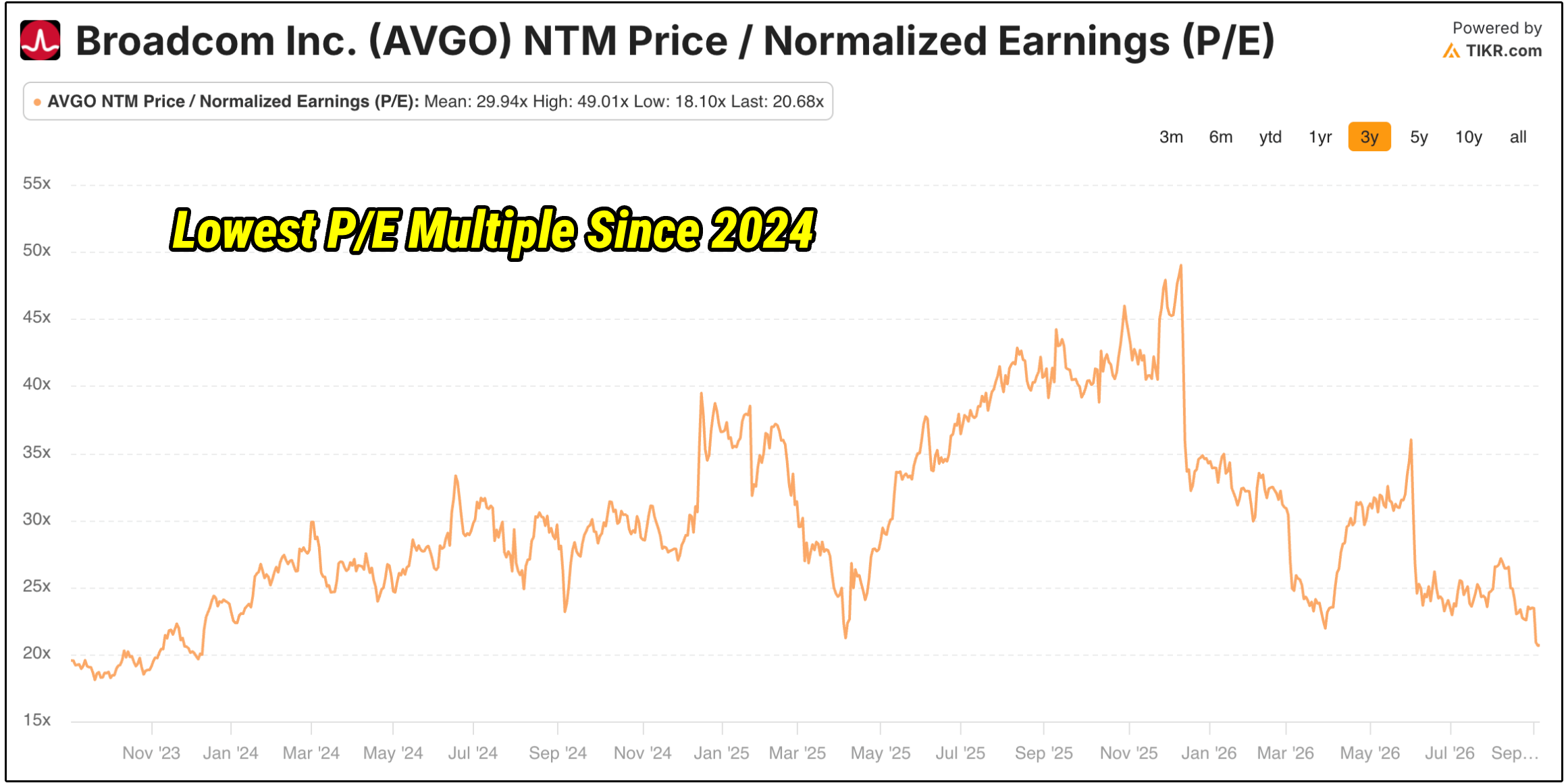
Broadcom’s forward normalized P/E has fallen to roughly 20.7x, its lowest level since 2024.
For context, the average multiple over the period shown above is roughly 29.9x, and at one point Broadcom traded near 49x forward earnings.
So even after a massive five-year run, the valuation today is much more reasonable than it was during much of the recent rally (since projected EPS growth is still so strong).
Analysts currently estimate EPS of roughly:
2026: $11.61
2027: $19.28
2028: $29.97
2029: $37.34
2030: $35.00
That works out to a projected EPS CAGR of roughly 31.8% from 2026 through 2030.
And the most recent quarter gave investors very little reason to believe the underlying growth story is weakening.
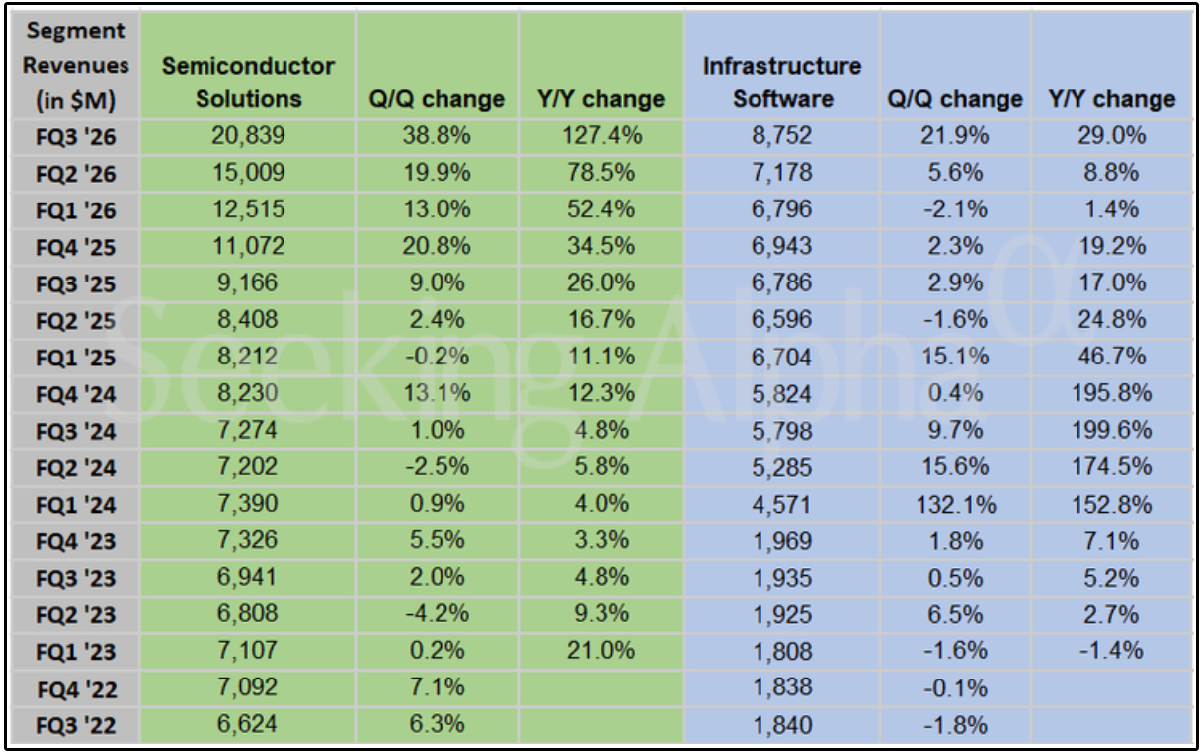
Broadcom reported Q3 non-GAAP EPS of $3.32, beating expectations, while revenue reached about $29.6 billion, up roughly 86% year over year. AI semiconductor revenue increased 221%, semiconductor solutions revenue grew 127%, and infrastructure software revenue increased 29%.
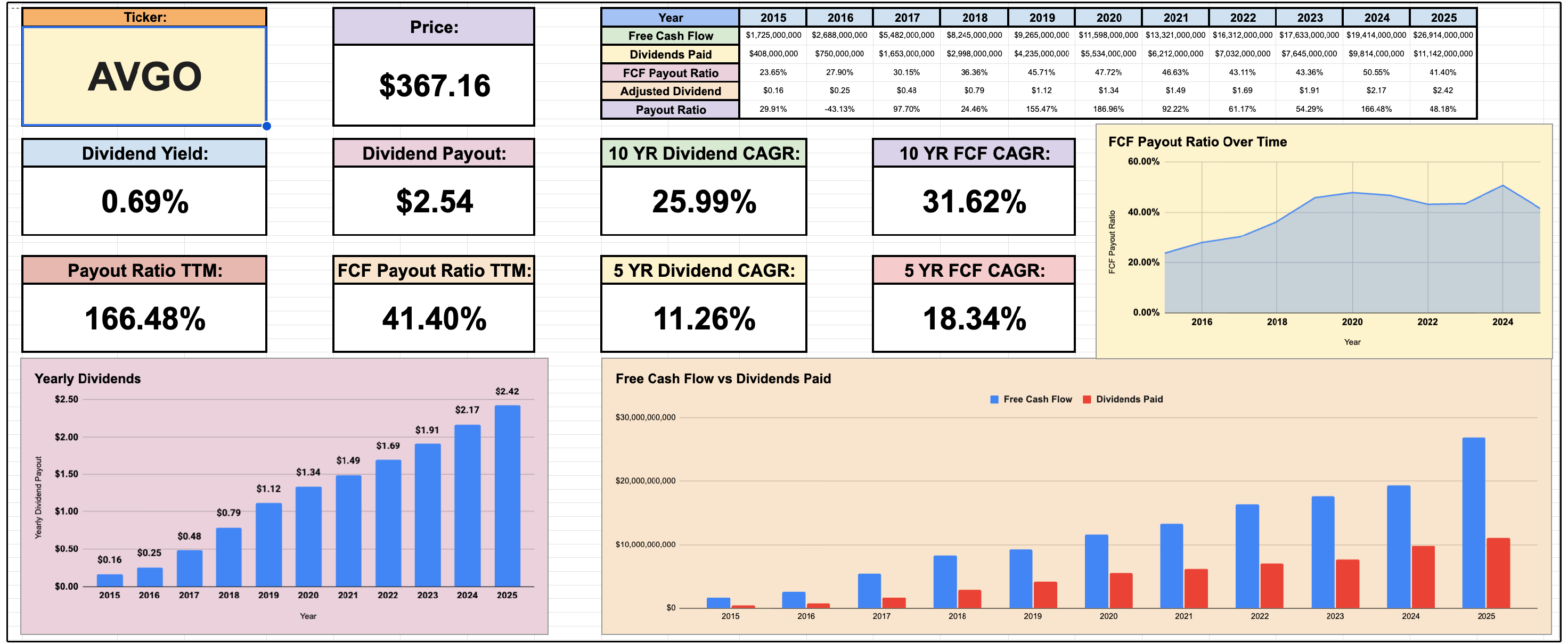
Broadcom has already generated roughly $31.9 billion in free cash flow through the first nine months of 2026, compared with about $26.9 billion in all of 2025.
As a result, the company’s 10-year dividend CAGR is roughly 26%, with the dividend growing from around $0.16 per share in 2015 to $2.42 in 2025.
So why did the stock sell off after earnings?
The main issue was Q4 revenue guidance of approximately $34.8 billion, slightly below the prior consensus of around $35 billion.
Selling off as a result of a slight quarterly miss is a big mistake.
Why?
Because management’s long-term outlook remains extremely strong.
Broadcom CEO Hock Tan said recently stated-
“We are very much on target to exceed $30 in earnings per share in fiscal 2028.” - Hock Tan
That is especially interesting because the current analyst estimate for 2028 is still below that level.
In other words, management is effectively signaling that Wall Street’s current earnings expectations may still be conservative.
The AI opportunity remains the primary growth engine, with Broadcom benefiting from huge demand for custom AI accelerators and networking infrastructure.
At the same time, VMware gives Broadcom a large recurring software revenue base.
That combination of explosive semiconductor growth and recurring software cash flow is extremely attractive.
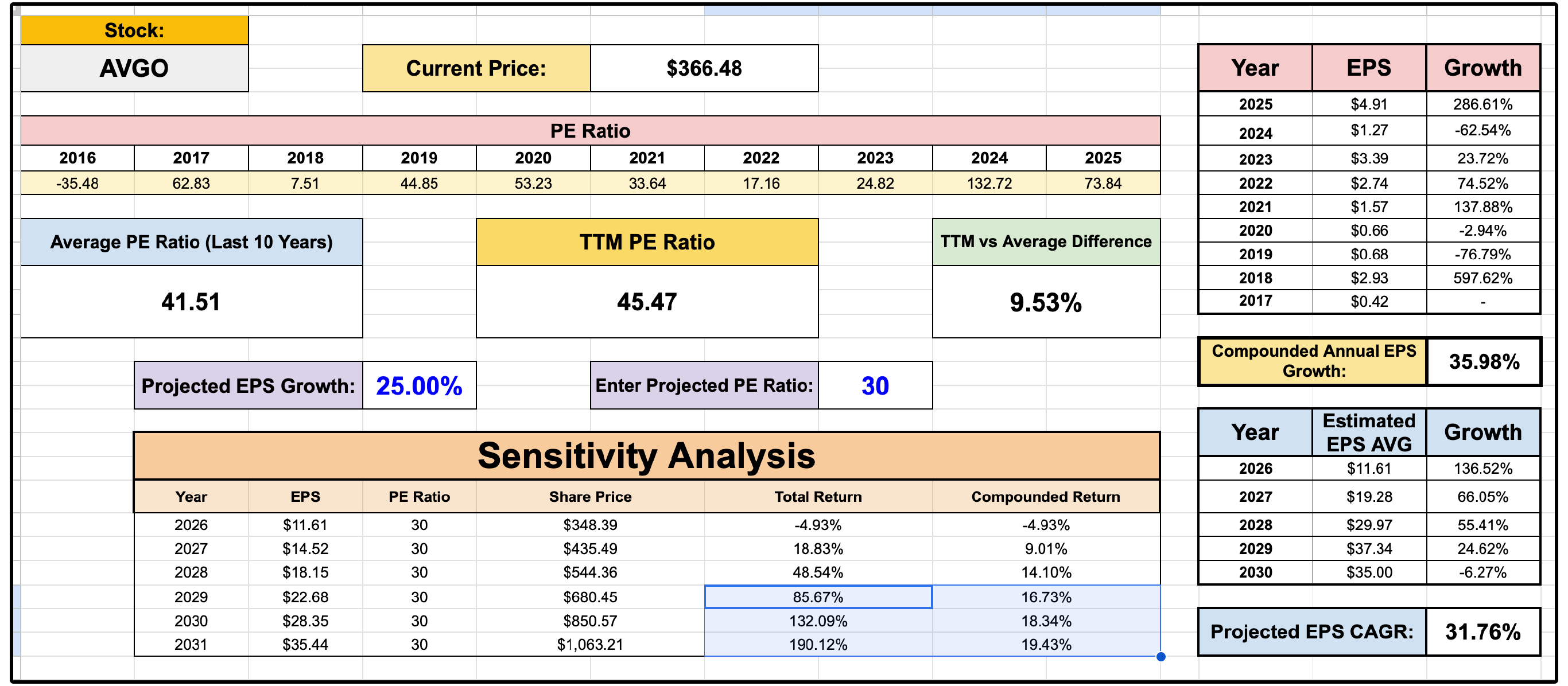
For the sensitivity analysis, if we assume Broadcom grows EPS at 25% annually and eventually trades at a 30x P/E multiple… (both below current projected levels)
Under those assumptions:
2026: $348
2027: $435
2028: $544
2029: $680
2030: $851
2031: $1,063
From today’s roughly $366 share price, that would imply a total return of about 132% through 2030, or an annualized return of roughly 18.3%.
And even if we use a much lower multiple, the setup still looks attractive.
If Broadcom reaches roughly $30 in EPS by 2028, (as management stated they expect), and trades at only 20x earnings, that would imply a share price of about $600.
So our model is even conservative relative to management expectations.
That is the key reason Broadcom remains so compelling.
The stock does not need multiple expansion.
It simply needs the earnings growth story to keep playing out.
For long-term investors willing to tolerate volatility, I still think the combination of AI growth, recurring software revenue, enormous free cash flow, and exceptional dividend growth makes AVGO one of the strongest dividend growth opportunities in the market.
3. 🏦 Blackstone (BX)
Time to do something I’ve never done before-
Allow someone else to list a stock on my monthly list of undervalued dividend stocks.
For the final stock on this month’s list, I wanted to include an idea that actually came directly from David Bahnsen.
I recently had David Bahnsen on the Mispriced podcast.
He is the founder, managing partner, and chief investment officer of The Bahnsen Group, where his firm manages roughly $10 billion in assets, and he has spent decades investing through a dividend-growth framework.
At the end of the interview, I asked him the same question I ask every guest:
What is one equity you currently believe is mispriced?
His answer was Blackstone (BX).
Bahnsen acknowledged that Blackstone has already rerated higher from where it traded earlier in the year, but he still believes the stock remains mispriced.
His reasoning was fairly straightforward:
“Blackstone remains below its all-time high while continuing to grow its cash flow and distributions, yet the stock is still being hurt by negative sentiment surrounding private credit and alternative asset managers.” - David Bahnsen
I think that distinction is extremely important.
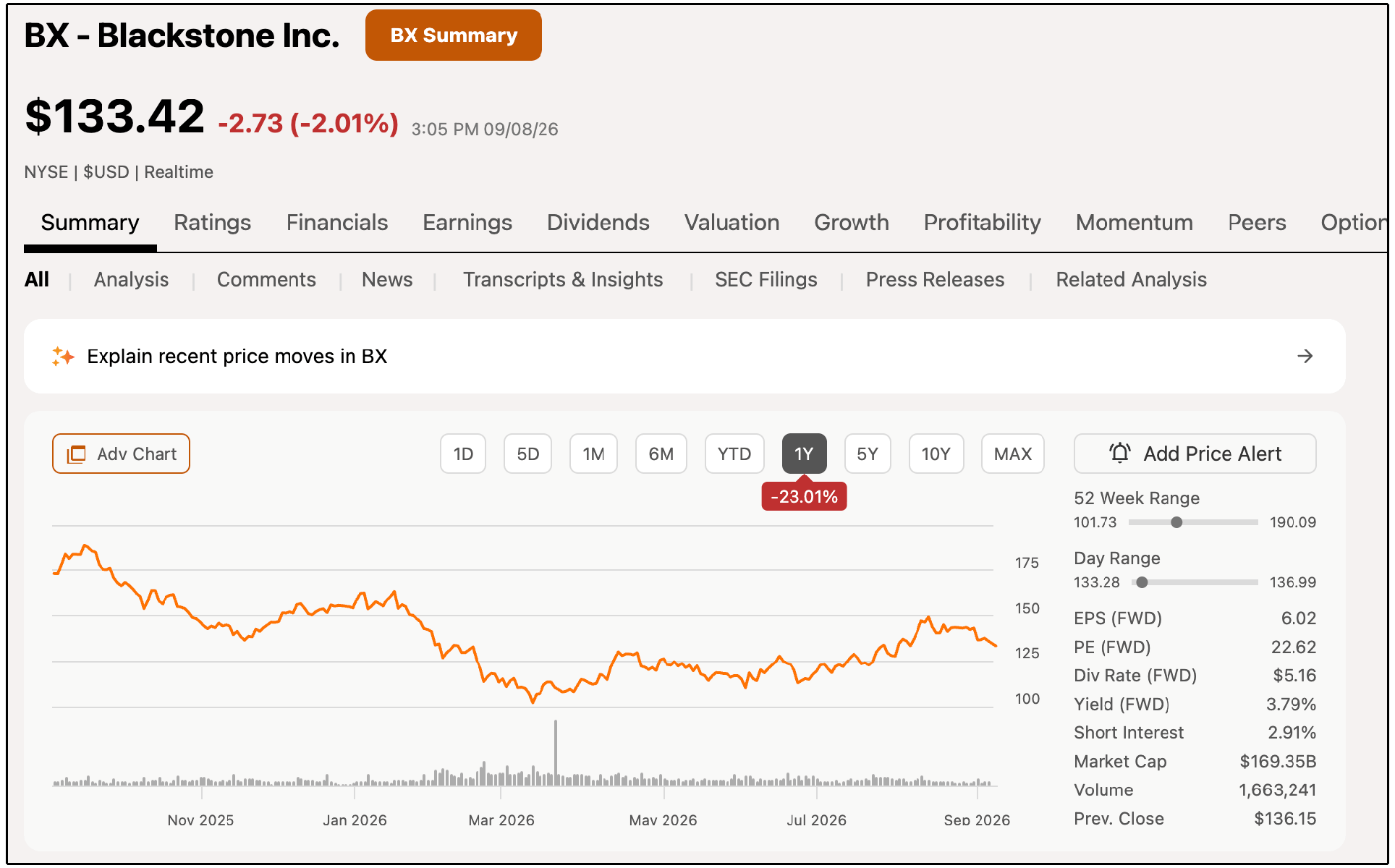
There is a difference between a business deteriorating and a stock being dragged down because investors dislike the industry it operates in.
Blackstone is the largest alternative asset manager in the world, with exposure across private equity, real estate, credit, infrastructure, and other alternative investments.
That creates an interesting setup because many investors currently hear words like “private credit” or “commercial real estate” and immediately become cautious.
And there are legitimate risks in those markets.
But negative sentiment toward an entire asset class can occasionally create opportunities in the highest-quality businesses operating within it.
Bahnsen’s argument is essentially that Blackstone’s underlying cash-generating power continues to improve even while the valuation reflects some of that broader skepticism.
Blackstone reported 22% growth in fee-related earnings and 26% growth in distributable earnings in Q2.
Distributable earnings came in at $1.52 per share, while fee-related earnings were $1.43 per share.
And one of the most important drivers is continued growth in assets under management.
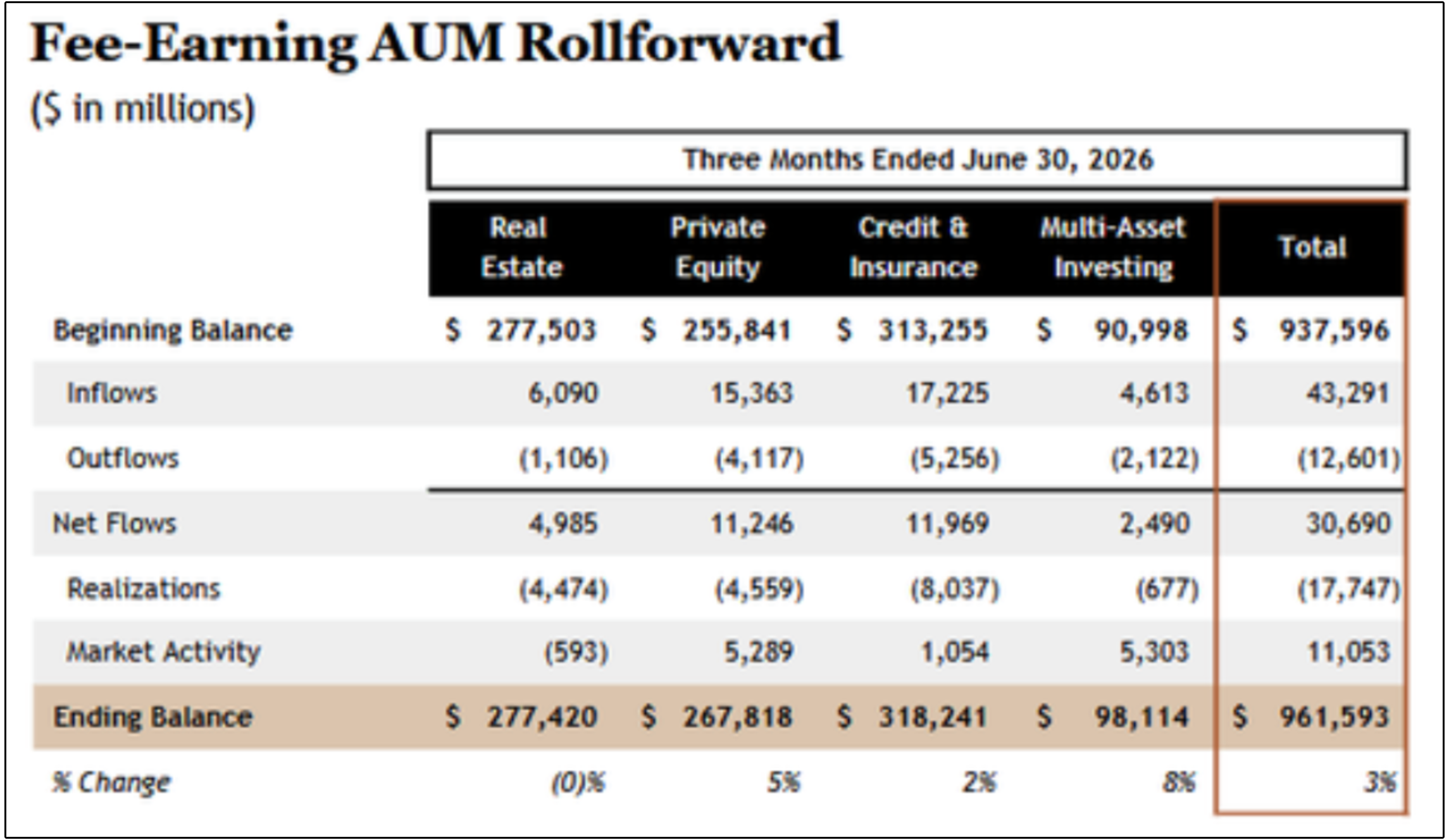
As you can see in the image above, Blackstone’s fee-earning AUM increased from roughly $937.6 billion to $961.6 billion during the quarter, a gain of about 3%.
Blackstone aslo brought in roughly $43.3 billion of fee-earning AUM inflows, partially offset by about $12.6 billion of outflows.
That produced more than $30 billion of net flows during the quarter.
Private equity fee-earning AUM increased about 5%, while multi-asset investing grew roughly 8%.
Credit & insurance also posted strong inflows, while real estate was essentially flat.
This is the core of the Blackstone business model.
More capital comes into Blackstone.
That capital gets invested.
The company earns management fees on a larger asset base.
Successful investments can generate performance fees and realizations.
And over time, that strengthens the Blackstone ecosystem and helps attract even more capital.
In other words, fee-earning AUM has the ability to compound, and fee-related earnings can compound along with it.
There is also an interesting AI angle here with Blackstone.
Blackstone is obviously not a traditional AI stock, but it has become a major beneficiary of the infrastructure buildout.
Management said 9 of its 10 largest investment markups in Q2 were AI-related.
Its dedicated infrastructure platform appreciated 7.2% during the quarter and 29% over the last year, while its QTS data center business was the largest driver of appreciation across the firm.
This type of exposure is interesting, because Blackstone does not necessarily have to predict which AI model ultimately wins.
It can provide capital to the infrastructure behind the trend: data centers, private credit, private equity, real estate, and power-related investments.
At around the valuation referenced in the research, Blackstone was trading at roughly 22.5x forward earnings/distributable earnings, below its five-year average.

This is a business with nearly $1 trillion of fee-earning assets that is still producing double-digit growth in earnings and attracting tens of billions of dollars of new capital each quarter.
Now, let’s jump into this month’s full list.